


Ruian Chuangbo Machinery Co., Ltd. is specialized in manufacturing of machinery parts.
A machined component may pass through several operations before it ever becomes a finished part ready to ship. Turning can establish the basic outer form, grinding can refine selected surfaces afterward, and milling can create additional features that the earlier stage never touched.
Each operation places different demands on how the workpiece actually gets held in the machine. A clamping method that suits one process may turn out to be a poor fit for the next one waiting down the line.
This becomes a lot more noticeable once manufacturers move the same component between several machines during a single job. Expanding Core Chucks can fit into this environment when the workpiece needs support from an internal surface during those later machining operations.
The main question here isn't how the chuck works internally, mechanically speaking. The more useful question is where a particular clamping approach fits within the production sequence, and how it affects the transition from one operation to the next. For manufacturers, this way of thinking can turn workholding into part of process planning, rather than treating it as some isolated machine accessory bolted on as an afterthought.
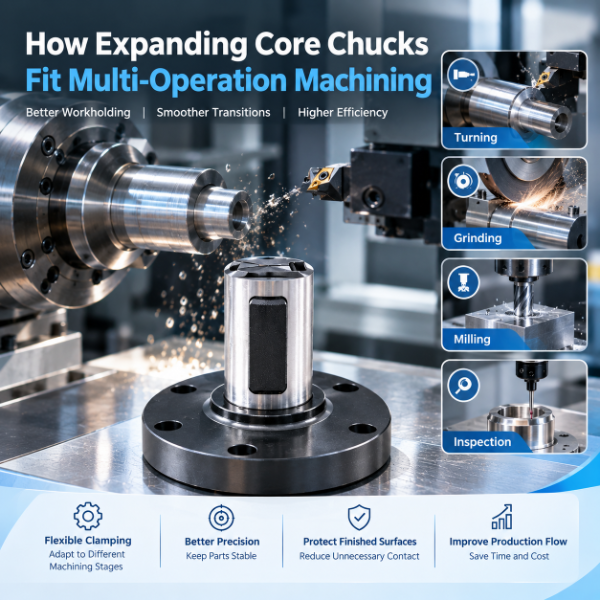
Why Do Different Machining Operations Need Different Clamping Approaches?
Turning, grinding, and milling don't interact with a workpiece in exactly the same way, even on the same part. The cutting direction can change entirely, the surface being processed can shift to a new area, and the workpiece may need repositioning for the next operation waiting in line.
This creates genuinely changing requirements for workholding as the job moves forward.
| Machining Operation | Clamping Consideration |
|---|---|
| Turning | Stable positioning during rotational machining |
| Grinding | Consistent support for the surface being processed |
| Milling | Secure holding against changing cutting directions |
| Inspection | Clear access to relevant surfaces |
| Secondary machining | Suitable positioning for remaining features |
A workpiece may begin with an external surface that is easy to grip during the initial setup. After turning, that same surface may become a finished area that should remain free from marks or disturbance during another clamping pass.
The next operation may therefore need a different contact location entirely. This is exactly where internal clamping can become useful on the floor. Rather than continuing to grip the same outside surface over and over, the production team can weigh whether an internal bore or core area offers a more suitable reference point for the next stage. The choice depends heavily on the component shape and the sequence of operations planned for that particular part.
How Can Expanding Core Chucks Fit Between Turning and Grinding?
Turning and grinding often show up together in the same production route, since different surfaces may call for different forms of machining on the same part. A component may get turned to establish its general shape before selected surfaces get refined through grinding afterward.
The workholding arrangement may need to shift between these two stages. During turning, external gripping may be convenient enough, since the outside of the workpiece is still available for machining at that point.
After that operation wraps up, though, the external surface may need protection from unnecessary contact going forward. An internal gripping method can offer another way to position the component for the next step.
Expanding Core Chucks can be considered for this type of transition whenever the workpiece has a suitable internal area for support.
| Production Stage | Possible Workholding Focus |
|---|---|
| Initial turning | Accessible external or internal reference |
| Later turning | Maintain suitable access to remaining surfaces |
| Grinding | Support without interfering with the target surface |
| Final inspection | Preserve access to finished areas |
The benefit comes from matching the holding location with the surface actually being processed at that stage. If the next operation focuses on the outside of a component, holding it from the inside can leave more of that outside surface available for the tool. This can make the transition between operations a lot easier to organize on a busy floor. It also gives production planners another option when deciding how a part should move through several machining stages in sequence.
When Does an Expanding Mandrel Chuck Become Useful in Multi-Operation Work?
An Expanding Mandrel Chuck can prove useful when a workpiece contains an internal opening that can serve as a holding location for a later stage. This arrangement can matter when the external surface needs to stay accessible during a later machining operation down the line.
For example, a turned component may have an internal bore usable for positioning during another process entirely. The workpiece can then get held from a different surface while the next operation focuses squarely on the outside.
This approach can cut down the need to repeatedly grip finished external areas that shouldn't get marked again. It can also help create a more consistent relationship between the workpiece and the machine across subsequent operations.
The practical suitability depends on the part's shape, its internal surface, the machining sequence, and the access each stage actually requires.
| Workpiece Condition | Possible Application |
|---|---|
| Internal bore available | Internal positioning |
| Finished outer surface | Avoid unnecessary external contact |
| Later external machining | Keep outside surface accessible |
| Repeated secondary operations | Support a consistent holding approach |
The important point is that an Expanding Mandrel Chuck should get considered in relation to the entire machining route, not just the operation directly in front of it. Selecting a workholding method only for one operation may create real difficulties once the component moves to the next machine. Looking at the sequence as a whole gives manufacturers a lot more room to coordinate clamping decisions across the whole job.
How Do Mechanical Chucks Fit Into a Changing Production Sequence?
Mechanical Chucks remain useful across many machining environments, since external gripping suits a wide range of production tasks without much fuss. They can be practical whenever the outside of the workpiece provides a suitable holding area and the machining operation needs access to another surface entirely.
The situation changes once the surface being gripped becomes part of the finished component itself. A later operation may need to process that same area, or the customer may simply require a clean external appearance with no marks.
In cases like that, an internal holding approach can provide another production option worth considering. This doesn't mean one type of chuck needs to replace another across the board.
Different workholding methods can serve different stages of the same production route without conflict.
| Machining Situation | Workholding Direction to Consider |
|---|---|
| External surface still available | Mechanical Chucks may suit the task |
| Outer surface needs machining | Consider another contact area |
| Internal opening available | Internal holding may be practical |
| Multiple operations | Match holding method to each stage |
This way of planning can help keep workholding from becoming a constraint that surfaces later in the process, once it's harder to fix. The production team can decide upfront where external gripping makes sense and where internal support may offer better access instead. The decision stays closely connected with the component's machining history up to that point. What was convenient at the beginning may not remain suitable once several surfaces have already been processed and finished.
Can One Workholding Strategy Support Several Machining Operations?
A single clamping approach may sometimes carry across multiple operations on the same part, but that shouldn't get assumed as always desirable. Different processes create genuinely different contact and access requirements from one stage to the next.
Turning may benefit from one arrangement, while milling may need the workpiece to resist movement coming from another direction entirely. Grinding can introduce its own concern too, since the surface being refined may need to stay unobstructed the whole time.
This makes a flexible workholding plan a lot more useful than forcing every operation into one fixed setup regardless of fit. A production team can identify the main contact surfaces needed at each stage of the job. The sequence can then get organized around those changes as they come up.
For example:
- The workpiece can begin with external holding during an initial machining operation.
- After the relevant outside surface is formed, the holding location can move to an internal area instead.
- A later operation can then access the outside without the same external obstruction in the way.
- Final machining can use a holding method that suits the remaining unfinished surfaces.
This approach treats workholding as part of the production route itself, not a separate puzzle solved machine by machine. It also cuts down the assumption that one chuck must perform the same role throughout the entire manufacturing process from start to finish.
How Does Milling Change the Clamping Requirement?
Milling introduces movement that may come from several directions at once, unlike the steady rotation of turning. The workpiece may need to stay firmly positioned while a cutter approaches different surfaces from different angles.
The required holding arrangement therefore depends heavily on the shape of the component and the features actually being created at that stage. A workpiece previously held for turning may need repositioning entirely before milling can even begin.
If the outside surface has already been finished, using it as the primary contact area may not be a good idea at all. An internal holding method can sometimes provide a workable alternative when the part geometry allows for it.
| Milling Situation | Clamping Consideration |
|---|---|
| Outer surface needs access | Avoid unnecessary external obstruction |
| Internal opening is available | Consider internal positioning |
| Several faces require machining | Plan access around the workholding |
| Finished surfaces are present | Protect important contact areas |
The production sequence matters here quite a bit, since milling may not even be the immediate operation right after turning finishes. Grinding, drilling, inspection, or another process may sit somewhere between them on the schedule. Each stage can change which surfaces remain available for clamping by the time milling actually starts. This makes the workholding plan a lot more closely connected with the full history of the part up to that point.
What Happens When a Part Moves Through Several Setup Changes?
Every setup change creates another moment where the workpiece has to get positioned and held all over again. The more varied the production route becomes, the more important it gets to understand why each change is actually happening.
Some changes happen simply because the next machine needs access to another surface entirely. Others happen because the previous holding area has already become a finished feature that shouldn't get disturbed again.
A clear sequence can make these transitions a lot easier to understand for everyone on the floor.
| Setup Change | Reason to Review Clamping |
|---|---|
| Turning to grinding | Finished surfaces may need protection |
| Grinding to milling | New machining faces may require access |
| Milling to inspection | Important surfaces need to remain visible |
| Secondary machining | Existing contact areas may no longer suit |
| Repeat processing | Consistent positioning may be useful |
Expanding Core Chucks can play a role whenever an internal surface offers a practical reference for one of these later stages. The value comes from their place within the sequence, rather than from treating them as some universal fix for every job. A production planner may lean on both external and internal holding methods at different points, depending on the workpiece condition at that moment. This creates a far more deliberate relationship between machining order and clamping location throughout the job.
How Can Workholding Choices Support Flexible Production Planning?
Production schedules often involve different part types moving through the same machining area during the same shift. One component may need turning and grinding together, while another moves straight from turning into milling with no grinding step at all.
A third part may need several secondary operations before it even reaches inspection. These differences make it genuinely difficult to apply one workholding pattern across every job coming through the shop.
Manufacturers can instead organize clamping decisions around each individual production route on its own terms. The key questions can include which surfaces remain unfinished, which areas need protection from further contact, and where the workpiece can be held without blocking the next machining task.
This approach proves particularly useful once production involves a wide variety of components moving through the same cell. A Mechanical Chucks setup may suit one stage just fine, while an Expanding Mandrel Chuck may make more sense once an internal opening has already been prepared. Expanding Core Chucks can provide another option whenever later operations need access to the outside of the workpiece.
The production team can then plan the transition ahead of time, rather than discovering the clamping problem only after the part reaches the next machine. This can also make production instructions a lot easier to organize, since each setup carries a clear purpose. The workholding decision becomes linked directly to what the machine actually needs to accomplish at that specific stage.
What Should Manufacturers Review When Matching Clamping With Machining Tasks?
A practical review starts with the component itself, rather than the chuck sitting on the shelf. Manufacturers can map out the surfaces that will get machined, finished, inspected, or protected throughout the whole production sequence.
This shows exactly where clamping may need to shift as the part develops through its stages. The production team can then compare the available workholding options against those changing requirements job by job.
Several questions can help structure that review on the floor.
- Which surface is available at the current machining stage?
- Which surfaces need to remain accessible going forward?
- Has an earlier operation already finished the potential contact area?
- Will the next operation approach the workpiece from another direction?
- Can internal holding provide useful access at this point?
- Does the workholding method fit the order in which the part is being processed?
These questions keep the discussion focused on actual production needs, rather than habit or convenience alone. They also help prevent the workholding method from getting chosen without considering what happens right after the current operation wraps up. An Expanding Mandrel Chuck, Mechanical Chucks, and Expanding Core Chucks can each find a place within different machining sequences depending on the job. Their practical role depends on the workpiece, the unfinished surfaces still remaining, and the operations still ahead on the schedule. When turning, grinding, milling, and secondary machining get viewed as connected stages rather than isolated events, clamping becomes part of the production arrangement itself, rather than a decision made separately at every single machine.
