


Ruian Chuangbo Machinery Co., Ltd. is specialized in manufacturing of machinery parts.
Anyone who has watched a slitting line in action knows how much depends on the shaft holding the roll. Film, paper, foil — whatever moves through the machine needs a stable connection between the shaft and the core, or things start slipping, swaying, or wrinkling in ways that create headaches downstream. Two common designs address this problem differently: a Multi Bladder Air Shaft and a Differential Air Shaft. They sound similar, and both use compressed air, but they solve different parts of the winding puzzle.
Picking between them isn't about brand preference. It comes down to what's actually happening on the line — whether the core needs secure gripping, or whether separate roll sections need room to behave independently as they build up.
What a Multi Bladder Air Shaft Actually Does
A multi bladder shaft works through several internal air bladders that expand when compressed air enters the shaft. As they inflate, they push gripping elements outward until contact is made with the inner wall of the core. That contact is what lets the shaft transfer rotation to the roll, whether winding or unwinding.
Release the air, and the gripping elements retract, so the core slides off without a fight. This matters on lines where cores get swapped frequently — a packaging operation running several jobs a shift doesn't want operators wrestling with manual adjustments every time.
| Component | Main Function |
|---|---|
| Shaft body | Supports the roll and transfers rotation |
| Air bladders | Expand when supplied with compressed air |
| Gripping elements | Contact the core and help secure it |
| Air inlet | Provides access for inflation and release |
| End fittings | Support the shaft structure and air connection |
The practical value of this design shows up on slitting lines processing wide film into narrower rolls. The shaft's job is simply to hold those cores firmly enough that the material doesn't shift as it travels through the machine. But a bladder system can't fix everything — a bent core or misaligned machine will still cause trouble no matter how well the bladders expand.
What Makes a Differential Air Shaft Different
A differential shaft solves a different problem entirely. When a wide web gets slit into several narrower lanes, those lanes rarely behave identically. One section might be slightly thicker, another might stretch more, and resistance during winding can vary from lane to lane. On a shaft without differential capability, every section gets forced to rotate at the same rate — and that mismatch shows up as some rolls winding tighter than others.
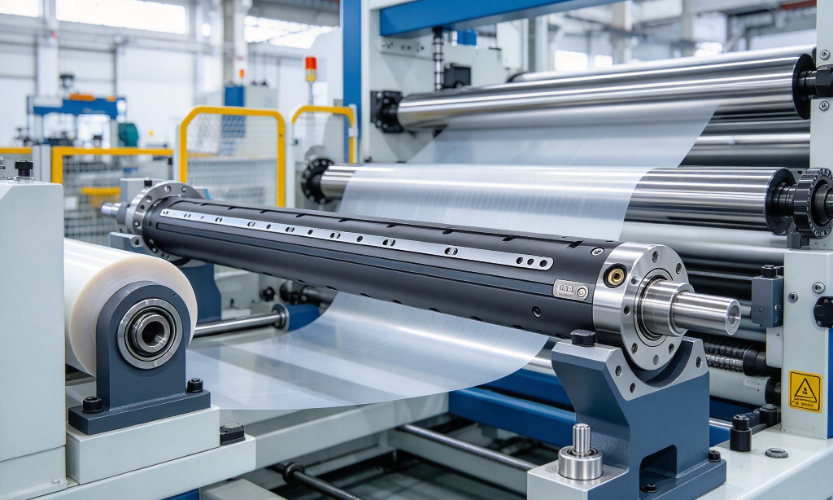
A differential design allows individual winding elements to adjust relative to the shaft when resistance between sections changes. Rather than forcing uniform behavior, each lane gets some latitude to respond to its own conditions. This becomes especially relevant with thin films, foil, or nonwoven materials where uneven tension shows up as visible defects rather quietly.
| Winding Condition | Possible Effect | Differential Design Response |
|---|---|---|
| Uneven material thickness | Roll sections build up differently | Allows sections to respond to resistance |
| Variation across web width | Tension differs between lanes | Supports individual winding behavior |
| Delicate film | Risk of stretching or deformation | Needs matched tension settings |
| Multiple narrow rolls | Sections need different movement | Permits controlled relative movement |
Think of a line producing battery separator film or thin packaging material in multiple lanes simultaneously. Without differential movement, one lane consistently winding tighter than its neighbors becomes a recurring quality issue rather than an occasional fluke.
Comparing the Two Designs Side by Side
The core distinction is purpose. One shaft type focuses on gripping; the other focuses on accommodating variation between sections. They're related tools, but swapping one for the other without understanding the actual production problem rarely solves anything.
| Comparison Point | Multi Bladder Air Shaft | Differential Air Shaft |
|---|---|---|
| Main purpose | Grip the core securely | Accommodate differences between sections |
| Operating principle | Bladders expand gripping elements | Sections respond to varying resistance |
| Main concern | Core holding and roll stability | Tension consistency across lanes |
| Typical use | General winding and unwinding | Multi-lane slitting and rewinding |
| Selection priority | Core fit and holding force | Material variation and lane behavior |
A packaging converter running single wide rolls through a laminator cares mostly about secure core holding — a multi bladder shaft fits that job well. A converter slitting thin film into a dozen narrow rolls at once faces a different challenge, and that's where differential movement earns its keep.
Matching the Shaft to Real Production Conditions
Choosing between these designs starts with looking at the actual winding task, not the product category. A line mainly swapping cores in and out benefits from reliable gripping and quick release — that points toward a multi bladder arrangement. A line splitting one web into several lanes with slightly different material behavior benefits from a shaft that lets each lane find its own winding rhythm.
Material type matters too. Flexible film stretches under uneven tension; paper can wrinkle if roll formation goes uneven; foil scratches easily if handling isn't controlled. Nonwoven fabric and separator film for batteries carry their own sensitivities, often requiring winding setups that avoid forcing uniform behavior across sections that simply aren't uniform to begin with.
Clamping force and shaft alignment deserve attention regardless of which design gets chosen. Too little gripping force and the core slips; too much and a weak core can deform. Poor alignment between shaft and roll creates its own swaying and vibration problems that no amount of bladder pressure or differential adjustment will correct on its own. Checking the core condition, bearing wear, and mounting points alongside the shaft itself gives a more complete picture of where a winding problem actually originates.
Maintenance and Purchasing Considerations
Routine inspection keeps either shaft type working as intended. For multi bladder shafts, checking for air leakage, uneven bladder expansion, and worn gripping elements catches problems before they affect production. Differential shafts need a different kind of attention — watching for unusual movement between sections, contamination inside the mechanism, and wear patterns specific to that design.
When ordering in volume, buyers get better results by describing the actual production problem rather than requesting a shaft by category alone. Sharing core dimensions, material type, number of winding lanes, and existing machine interface gives a supplier what's needed to recommend a workable fit. Clear packaging requirements for shipping also matter — these components can be sensitive to impact during transit, and protecting them before installation saves trouble later.
Communication between the production floor, purchasing team, and equipment supplier keeps the final choice tied to what the line genuinely requires, rather than to assumptions made from a catalogue page.
