


Ruian Chuangbo Machinery Co., Ltd. is specialized in manufacturing of machinery parts.
Tension drift is one of the more persistent problems in web-handling and winding operations. The material starts at the right tension, but over the course of a run it gradually tightens or loosens — and by the time the issue becomes visible, product has already been affected. Any qualified Magnetic Powder Brake Manufacturer will tell you that the root cause is rarely a single fault: it is usually a combination of roll diameter change, speed variation, and a braking mechanism that cannot adapt quickly enough to keep the output torque stable. A magnetic powder brake approaches this problem differently from mechanical friction systems, and understanding why requires looking at how torque is generated and controlled inside the device.
What Tension Drift Actually Is
The Problem Is Not Instability — It Is Lag
Tension drift is not random fluctuation. It is a directional shift in tension that develops over time as operating conditions change. A primary driver is roll diameter: as material unwinds, the roll gets smaller, and if the braking torque does not adjust correspondingly, the line tension changes.
A braking system that relies on mechanical friction to hold tension cannot make that adjustment smoothly. Friction-based systems respond to slipping and gripping rather than to a continuously adjusted set point, which means they introduce lag into the tension response — and lag, compounded over a long run, becomes drift.
Why Drift Damages Product Quality
Tension drift affects product differently depending on the material and process:
- In film and foil winding, it causes telescoping or star defects in the finished roll
- In printing, it produces registration errors as the web stretches or relaxes unevenly
- In slitting, it leads to edge curl, inconsistent slit width, and tracking problems
- In lamination, it affects bond quality as the substrate moves through the nip at inconsistent tension
The cost of tension drift is not just scrap — it is the cumulative quality degradation that builds up across a production run.
How a Magnetic Powder Brake Works
The Torque Mechanism Uses Magnetic Field, Not Friction
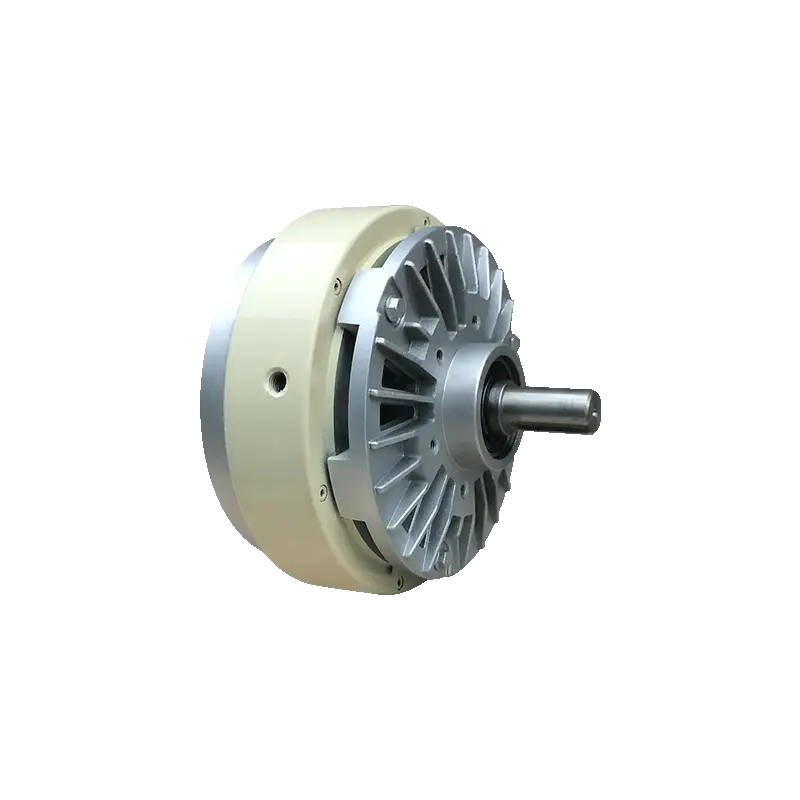
Inside this type of brake, a rotor sits within a housing separated by a gap filled with fine ferromagnetic powder. When current flows through the coil, it generates a magnetic field. That field causes the powder particles to form chains linking the rotor to the housing, creating resistance to rotation.
The braking torque is a direct function of the magnetic field strength, which is controlled by the excitation current. Increase the current and the torque increases. Decrease it and the torque drops — smoothly, proportionally, and without the stick-slip behavior that characterizes mechanical friction systems.
Does the Torque Respond Quickly Enough for Web Control?
Yes — and the response speed is one of the key reasons the device suits tension-sensitive applications. Because the torque output is controlled electrically rather than mechanically, the response to a change in the control signal is near-instantaneous. There is no mechanical inertia to overcome, no friction cone to engage or disengage.
In a closed-loop tension control system, this fast response allows the controller to correct for tension changes as they begin rather than after they have already affected the web. The correction happens within the same production cycle rather than lagging behind it.
The Specific Mechanism That Reduces Tension Drift
Proportional Torque Control Compensates for Roll Diameter Change
The primary cause of tension drift in unwinding applications is the change in effective radius as the roll unwinds. For a constant line tension, the braking torque must decrease as the roll diameter decreases — because a smaller roll radius converts a given torque into a higher line tension than a larger one.
A magnetic powder brake paired with a tension controller can receive a diameter signal and adjust the excitation current in proportion, keeping the torque output matched to the current unwinding radius. The tension on the web stays constant even as the roll geometry changes throughout the run.
Closed-Loop Control Catches What Open-Loop Misses
Open-loop systems set a fixed braking level and rely on that level being correct throughout the run. They cannot account for changes in material properties, line speed variations, or equipment wear.
A closed-loop system using a tension sensor — a dancer arm, load cell, or ultrasonic sensor — feeds real-time tension data back to the controller. The controller compares the measured tension to the set point and adjusts the current to the brake accordingly. Drift is corrected continuously rather than accumulating until it becomes visible.
The Powder Gap Eliminates Stick-Slip
Stick-slip is a friction phenomenon where two surfaces in contact alternate between sticking and sliding, producing a jerky, irregular force output. In mechanical braking systems, stick-slip is a source of short-cycle tension variation that adds noise to the tension signal and makes fine control difficult.
The powder gap means there is no direct mechanical contact between the braking surfaces during operation. The torque is transmitted through the magnetic field acting on the powder, not through surface contact. Stick-slip is structurally absent from the torque output, which gives the closed-loop controller a cleaner signal to work with.
Comparing Braking Technologies for Tension Control
| Feature | Friction Brake | Hysteresis Brake | Powder Brake (Magnetic Powder Brake) |
|---|---|---|---|
| Torque control method | Mechanical pressure | Magnetic hysteresis | Magnetic field via powder |
| Stick-slip behavior | Present | Absent | Absent |
| Response to current change | Not applicable | Fast | Fast |
| Torque linearity | Limited | Good | Good |
| Heat generation at sustained load | High | Moderate | Moderate — monitor temperature |
| Torque range | Fixed by design | Narrow–moderate | Wide — adjustable by current |
| Closed-loop compatibility | Limited | Good | Good |
| Maintenance requirement | Regular (wear parts) | Low | Periodic (powder condition) |
The powder brake occupies a practical position for applications that need a wide torque range, closed-loop compatibility, and smooth output — without the complexity of a servo-driven braking system.
Applications Where Tension Drift Affects Output Quality
Flexible Packaging and Film Converting
Flexible packaging lines run thin, easily deformed materials at speed. Any tension variation that exceeds the material's tolerance causes stretching, edge waviness, or printing misregistration. The combination of high speed and sensitive material means the braking system must respond faster than the drift develops.
A powder brake in closed-loop configuration can maintain the web tension within a tight band even as roll diameter changes and line speed varies, which supports consistent print registration and seal quality across the full roll.
Paper and Paperboard Converting
Paper converting involves materials with relatively higher stiffness than film, but the challenge is volume: large rolls, long runs, and significant roll diameter change from full to core. Tension must be maintained across this full diameter range without operator intervention.
The wide torque range available from this type of brake — adjusted continuously by the controller — allows a single device to cover the full unwinding arc from a full roll to a nearly exhausted core without reaching the limits of its control range at either end.
Printing Presses and Label Production
Printing applications are particularly sensitive to tension variation because tension directly affects the registration accuracy between print stations. A tension change that moves the web by even a fraction of a millimeter between stations is enough to push registration outside tolerance.
Closed-loop tension control with fast current response keeps the web tension stable between stations, supporting consistent multi-color registration across long print runs.
Wire and Cable Winding
Wire and cable winding involves precise tension to ensure consistent layer formation and conductor integrity. Inconsistent tension during winding causes irregular layer buildup, which affects the electrical and mechanical properties of the finished cable.
The smooth, proportional torque output — without the jerky behavior of friction systems — produces a consistent winding tension that translates into better layer uniformity in the finished product.
Practical Considerations for System Integration
Matching the Brake to the Load
The braking torque range must cover the full operating range of the application — from the tension required at full roll diameter to the usable torque at core diameter. Selecting a brake whose rated torque range matches the application range keeps the controller working within the linear control region.
Undersizing the brake causes the system to reach the upper limit of its torque range before the required tension is achieved. Oversizing reduces the proportion of the torque range being used for control, which compresses the effective resolution of the closed-loop system.
Temperature Management During Extended Runs
These brakes generate heat during operation, particularly at higher torque levels and sustained slip. If the operating temperature exceeds the rated range, the powder properties change, which affects the torque-current relationship and reduces control accuracy.
Practical temperature management steps include:
- Monitoring the brake housing temperature during extended production runs
- Ensuring adequate airflow around the brake body
- Selecting a brake with a thermal rating that matches the duty cycle of the application
- Considering water-cooled models for high-duty-cycle applications with sustained high torque
Controller Selection and Signal Compatibility
The brake requires a controller capable of generating the excitation current range the specific brake model requires. The controller also needs to accept the tension feedback signal from the sensor type in use — dancer arm, load cell, or ultrasonic — and convert it to a current correction output.
Verifying controller-brake-sensor compatibility before commissioning avoids integration problems that are difficult to diagnose once the system is assembled.
Sourcing a Magnetic Powder Brake for Your Application
Selecting the right brake involves matching torque range, shaft configuration, voltage rating, and thermal characteristics to the specific machine and process. A supplier who understands the application context — not just the product catalog — can help identify the configuration that will perform correctly in the operating environment. Ruian Chuangbo Machinery Co., Ltd. manufactures magnetic powder brakes and tension control components for printing, packaging, film converting, and winding applications. Their engineering team can support application-specific selection by reviewing torque requirements, controller compatibility, and duty cycle to recommend a configuration suited to the operating conditions. If you are evaluating brake options for a tension control system or replacing an existing device, reaching out with your application parameters — material type, line speed range, roll diameter range, and current controller type — gives their team what they need to provide a useful recommendation.
