


Ruian Chuangbo Machinery Co., Ltd. is specialized in manufacturing of machinery parts.
In web processing and roll handling, small changes in winding conditions can alter how a roll behaves. A shaft may hold the core securely at the start of a job, yet movement can appear as tension changes or as the material builds into a larger roll. When operators compare shaft designs, stability is frequently the main concern.
A Multi Bladder Air Shaft uses inflatable elements that expand against the inside of the core. A standard air shaft grips through a different expansion arrangement. Both are intended to hold the roll in position, and their performance depends on construction, core condition, material, machine setup, and process. The relevant question is how each design behaves with a specific core, material, and machine.
What Stability Means in Roll Handling
Stability covers several separate aspects. It can refer to how securely the core is held, whether the roll stays centered, how well rotation passes from shaft to core, or how the setup responds when tension changes. A shaft may grip firmly while the roll still moves because the core is damaged or the machine is misaligned. Another shaft may stay centered while the web winds unevenly because of a tracking problem.
| Stability Factor | What It Helps Assess |
|---|---|
| Core grip | Whether the core stays securely held |
| Contact distribution | How support is applied around the core |
| Centering | Whether the roll stays aligned |
| Torque transfer | How rotation passes between shaft and core |
| Operating consistency | Whether the setup stays steady as conditions change |
A shaft design can support steady operation. It cannot correct every problem that originates in the core, the material, the machine, or the process.
How Each Shaft Grips the Core
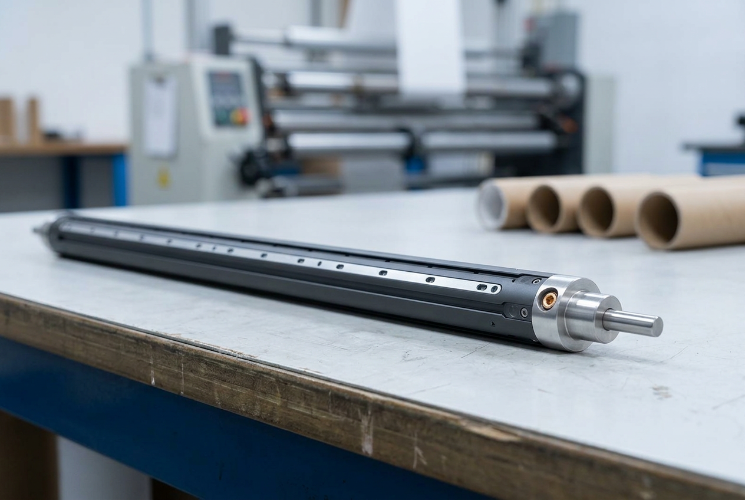
Multi bladder grip
Bladder elements expand against the inner surface of the core when the shaft is activated. Several contact areas can spread the gripping force around the core, which suits jobs with frequent roll changes and repeated loading.
The result still depends on bladder placement, the core surface, and how evenly the shaft expands. A cracked core, a worn bladder, or incorrect inflation disrupts the intended contact pattern. The design is a particular way of making contact. It does not ensure that every roll stays steady under every condition.
Standard shaft grip
Standard shafts push gripping elements outward under air pressure, and the contact pattern differs between types. A suitable standard shaft holds a core securely and is often simple to inspect and service.
A different contact arrangement does not make it unstable. Worn gripping parts, a poor core surface, or a loose fit cause more trouble than the basic mechanism. In a well-matched application, the standard design can provide the grip the job requires.
Is the grip more even?
Several bladders can create several support areas, which is why many buyers consider this design. The number of contact areas settles little on its own. Placement, construction, and the condition of both shaft and core matter more.
| Design Consideration | Why It Matters |
|---|---|
| Bladder placement | Influences where the shaft touches the core |
| Core condition | Affects the quality of the contact surface |
| Expansion consistency | Changes how the gripping elements engage |
| Component condition | Affects repeatability over continued use |
| Shaft alignment | Helps decide how the roll sits in the machine |
A well-matched standard shaft can outperform a poorly matched multi bladder one. Both should be compared using the actual core and operating conditions.
Core Quality, Speed, and Upkeep
The core is part of the grip
The inner surface of the core is what the shaft presses against. Crushed, split, worn, or uneven cores give inconsistent contact, and the roll can shift even when the shaft is in good order. Quality varies between suppliers and between batches.
Reused cores deserve closer inspection. Internal damage may not be visible from outside, and a core that has been loaded many times may no longer seat as a new one does. Incoming cores should be checked, and shafts should be tested with the cores actually used in production.
Winding symptoms have many causes
Slipping between shaft and core can appear as uneven winding, shifted roll alignment, or visible movement. Incorrect tension, poor web tracking, damaged material, and machine misalignment produce similar signs.
Replacing the shaft without identifying the cause may change nothing. The core, shaft, roll position, web path, and machine response should be observed together before deciding where the fault lies.
Operating speed
Acceleration, slowing, and a growing roll diameter change the forces acting on the assembly. A shaft that holds well at loading may behave differently as the machine ramps up. Assuming that a multi bladder design is automatically steadier at higher speed would mislead buyers.
The shaft should be run under real production conditions, with the whole setup kept within the manufacturer's stated limits. Unusual demands should be discussed with the supplier before purchase.
Maintenance
Bladders, gripping elements, seals, and valves wear with use. On a multi bladder shaft, a leak or uneven expansion in the inflatable parts changes how the core is engaged. Standard shafts need equal attention on their expansion and gripping components.
Inspection should cover visible damage, changes in inflation behavior, unusual movement, and signs that the core is no longer held firmly. Follow the instructions for the specific shaft, and assess any suspected defect before returning it to service. Regular checks also help separate normal wear from problems rooted in the core or machine.
Roll Changes and the Differential Air Shaft
Handling during changeovers
Shaft weight, access to the inflation point, working space, core fit, and release procedure shape the roll-change routine. Either design can suit an operator who is trained on it and has room to work. The frequency of roll changes and the ease of installing, removing, and inspecting the shaft should both be considered.
Where a differential shaft fits
A Differential Air Shaft suits jobs where several rolls on one shaft need some independence. Slit lanes with different winding behavior are a typical case, as is a requirement for even tension across lanes. A multi bladder design focuses on gripping the core. A differential design answers a different need, so the two should not be interchanged without understanding the task.
| Shaft Type | Main Design Focus |
|---|---|
| Multi Bladder Air Shaft | Core gripping through inflatable elements |
| Standard air shaft | Core gripping through its own expansion mechanism |
| Differential Air Shaft | Independent roll movement in suitable applications |
Construction varies between products. The operating principle should be confirmed with the supplier and not inferred from the product name.
Comparing and Choosing
The comparison should begin with the actual problem. For core slipping, examine the gripping mechanism and the condition of the core. For uneven winding, also review tension, tracking, alignment, and material condition.
| Evaluation Area | Questions to Consider |
|---|---|
| Core compatibility | Does it suit the cores used in production? |
| Gripping behavior | Does the core stay held during operation? |
| Roll handling | Can operators load and release it easily? |
| Process conditions | Does it suit the machine and material? |
| Maintenance | Can parts be inspected and serviced? |
| Supplier support | Are instructions and product details available? |
A side-by-side trial under identical conditions is more informative than product descriptions. Use the same core, material, and machine settings, and observe how each shaft behaves across a full run.
Before contacting a supplier, gather the core type, the material, the machine layout, the roll-change routine, and a clear description of what stability means in the application. Slipping, roll movement, uneven winding, and difficult release are different problems, and each points to a different answer. If a differential design is under consideration, confirm that the process requires independent roll movement and not only core grip. Clear application details narrow the choices and keep the discussion on installation, operation, and upkeep.
