


Ruian Chuangbo Machinery Co., Ltd. is specialized in manufacturing of machinery parts.
A roll of packaging film comes off a winder with one edge slightly looser than the other, and by the time it reaches the next station, the material has started telescoping — sliding sideways off the roll's edge in a way that ruins an entire batch. That kind of problem rarely traces back to bad material. More often it traces back to tension that wasn't controlled consistently enough during winding.
Why Tension Keeps Showing Up as a Production Problem
Anyone running a line that handles film, paper, textiles, or similar flexible materials knows how much can go wrong from something as simple as uneven resistance during winding or unwinding. A roll that spins too loosely develops wrinkles or uneven layers. One that gets wound too tight puts stress on the material that shows up later as stretching, distortion, or breakage during the next processing step.
This is a common situation in any production line that handles rolled materials. The difference between steady operation and frequent rework often depends on how effectively tension is controlled throughout the material handling process.
| Production Need | Practical Purpose |
|---|---|
| Steady material movement | Maintains consistent processing throughout the entire roll cycle |
| Even product appearance | Avoids visible wrinkles, waviness, or uneven winding |
| Fewer mid-run interruptions | Reduces stoppages caused by material slipping or misaligning |
| Handling different materials on the same line | Lets one setup work across product changes without a full rebuild |
A line that switches between a heavier packaging film in the morning and a thinner textile material in the afternoon needs tension control that adjusts without requiring a mechanical overhaul each time.
What an Electromagnetic Powder Brake Actually Does
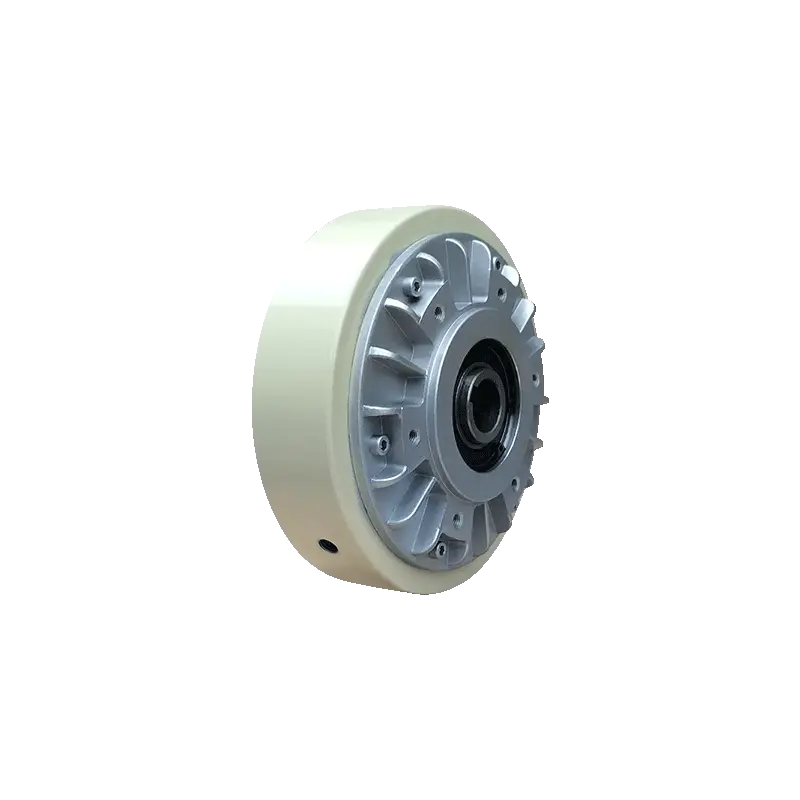
At its core, this brake creates adjustable resistance using an electromagnetic field acting on a fine powder medium between two rotating parts. Increasing the current strengthens the magnetic field, which increases how tightly the powder binds the rotating components together, and that translates directly into more braking resistance. Reduce the current, and the resistance eases off.
This matters because it replaces a mechanical adjustment — physically tightening or loosening a brake pad or clutch — with something that can be dialed in electronically, often in response to real-time feedback from the line itself.
| Component | Function |
|---|---|
| Brake body | Holds the rotating and stationary parts together |
| Electromagnetic system | Generates the field that controls braking strength |
| Powder medium | Transfers resistance between the rotating components |
| Connection parts | Links the brake into the shaft and control system |
An operator adjusting tension on a roll of paper doesn't need to stop the line and manually reset a mechanical clutch. The resistance can shift smoothly while material keeps moving, which matters on a line that can't afford frequent stops.
Why Smooth Adjustment Matters More Than It Sounds
Mechanical braking systems tend to work in steps — tighten a bolt, adjust a lever, and the resistance changes in a jump rather than a gradual curve. That kind of sudden shift can show up in the material itself as a visible mark or inconsistency at the exact point the adjustment happened.
Electromagnetic control avoids that abruptness. Resistance changes gradually as current changes, which means a line adjusting for a slightly thicker section of material, or compensating as a roll's diameter shrinks during unwinding, doesn't introduce a visible jolt into the process.
This shows up in practice as:
- Tension that adjusts automatically as roll diameter changes during unwinding
- Smoother handoffs when material properties shift slightly partway through a roll
- Easier integration with automated control systems that monitor tension continuously
- Less manual intervention needed during a normal production run
A packaging plant running unattended overnight shifts benefits directly from this kind of automatic adjustment, since nobody's available to manually retune a mechanical brake at 3 a.m.
How This Connects to the Shaft Holding the Material
A brake alone doesn't control tension — it needs something to act on, and that's where the air shaft comes in. The shaft holds the material roll in place and transmits the brake's resistance to the actual rotating roll. If the shaft doesn't grip the roll's core securely, even a well-tuned brake won't produce consistent tension, because some of that resistance gets lost to slippage between the shaft and the core.
This is part of why Air Shaft Spare Parts matter more than they might seem to on paper. A worn seal or a damaged locking bar inside the shaft can quietly undermine tension control even when the brake itself is functioning correctly. Keeping these parts in working condition isn't just routine upkeep — it's part of what makes the whole tension system reliable.
| Component | Role in Production |
|---|---|
| Electromagnetic Powder Brake | Generates and adjusts resistance |
| Air shaft | Holds the roll and transmits that resistance to it |
| Air Shaft Spare Parts | Keep the shaft's grip and function consistent over time |
| Control system | Coordinates brake output with shaft behavior |
A maintenance technician replacing a worn air shaft seal isn't doing cosmetic upkeep — they're preserving the mechanical link that makes the brake's tension control actually reach the material.
Why Lighter Shafts Are Showing Up More Often
Anyone who's manually loaded a heavy shaft onto a winder knows how much effort that takes, especially during frequent roll changes on a line running several product types a day. A Lightweight Air Shaft addresses this directly by reducing how much physical effort goes into installation and removal.
This matters beyond operator comfort. A shaft that's easier to handle also gets changed more quickly between jobs, which shortens downtime during product switches. On a line running mixed batches throughout a shift, that time savings adds up.
| Feature | Practical Value |
|---|---|
| Easier physical handling | Reduces strain during frequent shaft changes |
| Fits varied production setups | Works across different roll sizes without needing a heavier alternative |
| Simpler maintenance | Easier to remove, inspect, and reinstall |
| Less operator fatigue | Matters on lines with frequent manual roll changes |
A textile operation switching fabric rolls several times a shift benefits from a shaft that doesn't require two people or a lift assist just to move it into position.
Where Expanding Core Chucks Fit Into This
Once a roll is loaded onto a shaft, it still needs to stay centered and gripped securely while it spins, sometimes at speeds that would expose any looseness immediately. Expanding Core Chucks handle this by gripping the material's core from the inside, expanding to fit snugly and keeping the roll aligned during rotation.
Without this secure grip, a roll can wobble slightly during unwinding, and that wobble translates into inconsistent tension regardless of how well the brake itself is calibrated. The chuck, the shaft, and the brake all need to work together — a weak link in any one of them shows up as a quality issue somewhere further down the line.
Their role includes:
- Holding the material core securely enough to prevent slipping during rotation
- Keeping the roll properly centered on the shaft
- Supporting smooth, consistent rotation without wobble
- Working alongside the brake and shaft as one coordinated system
A printing operation running a roll at speed depends on this kind of secure grip just as much as it depends on the brake itself — one without the other doesn't produce a stable result.
Where These Systems Actually Show Up
Different industries lean on tension control for different reasons, but the underlying need — keeping material moving evenly without excess slack or strain — stays consistent across all of them.
| Industry | Application Example |
|---|---|
| Packaging | Managing film tension during winding and unwinding |
| Printing | Keeping paper or film moving evenly through the press |
| Textile | Controlling fabric tension during processing and finishing |
| Paper production | Handling roll tension during winding operations |
A packaging line and a textile mill might look completely different on the floor, but both depend on the same basic principle — resistance that adjusts smoothly rather than in abrupt steps.
Why Flexibility in Equipment Design Keeps Mattering
Production lines rarely stick to one material or one product size for long anymore. A line might run a heavier packaging film one week and a lighter, more delicate material the next, and equipment that only works well for one of those situations creates a bottleneck the moment requirements shift.
Modern tension control design tends to focus on:
- Making it easier to integrate the brake with existing line control systems
- Simplifying how operators adjust settings between different jobs
- Ensuring compatibility across different shaft and chuck combinations
- Keeping maintenance straightforward enough that downtime stays limited
A converting operation that regularly takes on custom orders benefits directly from equipment that adjusts to new material specs without requiring a hardware swap each time.
What Actually Matters When Choosing This Kind of Equipment
It's easy to look at a brake in isolation and judge it purely on its resistance range, but that misses how much the surrounding components affect real-world performance. A brake paired with a poorly matched shaft or an unreliable chuck won't deliver consistent tension no matter how precise the brake itself is.
| Selection Factor | Reason It Matters |
|---|---|
| Material type | Different materials need different tension ranges and response speeds |
| Production process | Determines how often and how quickly tension needs to adjust |
| System compatibility | Brake, shaft, and chuck need to work together without mismatched specs |
| Maintenance planning | Ongoing part replacement keeps performance consistent over years of use |
A plant manager evaluating new tension control equipment does better asking how the brake performs as part of a full system, rather than treating it as a standalone purchase decision.
Where This Kind of Equipment Is Headed
Manufacturing lines will keep shifting toward handling more product variety within the same production schedule, and tension control equipment needs to keep adjusting alongside that shift. A brake that only works well under one narrow set of conditions becomes a limitation the moment a line's job mix changes.
Electromagnetic Powder Brakes continue showing up across packaging, printing, textile, and paper operations because they offer the kind of smooth, adjustable resistance that fits into this ongoing variability. Paired with well-maintained shafts and secure chucking systems, they form a tension control setup that adapts rather than forcing a line to work around its own equipment limitations.
