


Ruian Chuangbo Machinery Co., Ltd. is specialized in manufacturing of machinery parts.
Film slitting machines divide wide rolls into narrower ones for different production needs. During this process, the winding shaft must hold each core securely while letting operators load, position, and remove rolls without delay. The shaft setup affects roll stability, handling time, and the consistency of daily production.
A Multi Bladder Air Shaft expands against the inner surface of a roll core when air pressure is applied. The expansion spreads gripping force across several contact areas, and the bladders retract when the air is vented. A Differential Air Shaft serves a related purpose on shared shafts, allowing individual rolls to rotate with some independence. Choosing between them depends on the machine, the film, the cores, and the roll layout.
What Should You Check Before Configuring the Shaft
Which Factors Shape the Setup
Slitting jobs vary in film flexibility, core construction, roll width, and winding layout. A shaft that works well on one line may need a different setup on another. A good starting point is the fit between shaft and core. With the bladders deflated, the core should slide on easily. Once the shaft expands, contact should be even and should not deform the core.
| Configuration Factor | What to Review |
|---|---|
| Core dimensions | Confirm the core suits the shaft's intended range |
| Core material | Consider rigidity and current condition |
| Film properties | Review flexibility, surface behavior, and tension sensitivity |
| Roll arrangement | Identify the number and position of slit rolls |
| Machine interface | Check mounting, drive connection, and clearance |
| Operating conditions | Consider loading frequency and handling habits |
The physical layout deserves attention as well. Operators need room to slide on cores, connect the air line, and pull finished rolls. Guards, idler rollers, and other nearby components should not block those movements. Collecting this information before purchase or installation helps suppliers identify compatibility problems early.
How Does the Multi-bladder Structure Grip the Core
When air enters the shaft, the bladders press against the inside of the core and transfer the turning force needed for winding or unwinding. When the air is released, the bladders retract and the core comes off with little effort. This cycle supports repeated roll changes without a complicated mechanical adjustment for every core.
Grip does not come from simply adding pressure. Too much pressure can crush a thin paper core or stress shaft components. Too little allows the core to slip, which shows up as wandering rolls or uneven edges. Follow the manufacturer's operating guidance instead of adjusting by feel, and confirm that every core is secure before starting the machine.
A damaged or out-of-round core also causes uneven contact. A cracked end or a crushed section can make one lane grip differently from its neighbors, so inspect cores before loading them.
How Do Film, Cores, and Roll Layout Fit Together
How Should the Shaft Match the Film and Core
Films behave differently on the machine. Some stretch readily under tension, while others are stiff or easily marked by contact. Cores differ as well. A paper core and a rigid plastic core respond differently to gripping pressure, even when their dimensions look similar. Film and core should be treated as one connected system.
| Material or Core Trait | Configuration Consideration |
|---|---|
| Flexible film | Keep tension and roll alignment steady |
| Stretch-sensitive film | Avoid unnecessary changes in winding conditions |
| Rigid core | Confirm dimensional fit and grip contact |
| Easily compressed core | Follow pressure guidance closely |
| Damaged or uneven core | Replace before use |
A stretch-sensitive film may change roll shape if winding conditions drift. If the core also deforms under grip, review core and shaft compatibility instead of chasing the problem through air pressure alone. The aim is a stable connection that preserves the condition of the material.
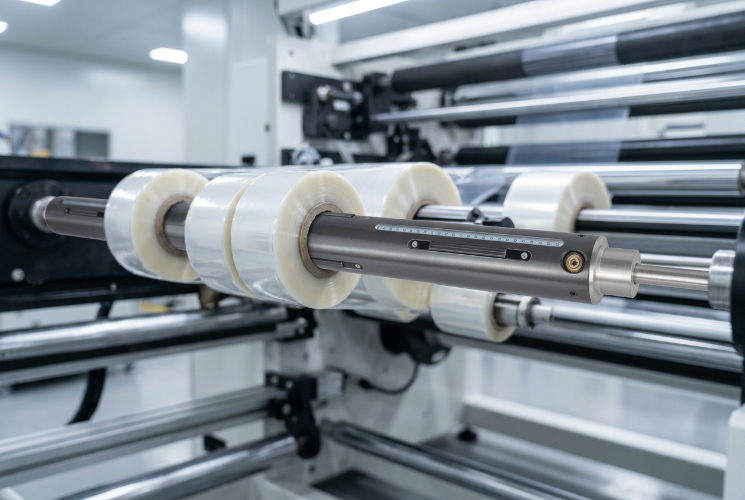
How Should Slit Rolls Sit on the Shaft
A single wide web often becomes several narrow rolls, and their positions must match the slitting plan. A misplaced core can push a finished roll off its intended path and make unloading awkward. A steady routine reduces errors:
- Review the slitting plan and note the position of each roll.
- Check that cores fit the shaft and suit the film.
- Place cores as the machine setup instructions describe.
- Confirm each core is properly engaged.
- Look for movement or contact with neighboring rolls before running.
The shaft's working length must match the planned layout. A setup with too little room for the intended cores complicates loading and may stop the machine from running as planned.
Unloading deserves equal thought. A configuration that loads quickly but releases slowly wastes time over many production cycles, especially on shifts with frequent roll changes.
When Is a Differential Air Shaft the Better Fit
How Do the Two Shaft Types Differ
A Multi Bladder Air Shaft concentrates on gripping cores so that rotation transfers evenly. A Differential Air Shaft allows individual rolls on a shared shaft to turn with relative independence. That helps when lanes wind under slightly different tension or reach slightly different diameters.
| Consideration | Multi Bladder Air Shaft | Differential Air Shaft |
|---|---|---|
| Main function | Expands to grip roll cores | Lets rolls rotate with relative independence |
| Core engagement | Expanding bladder contact | Differential gripping arrangement |
| Typical concern | Core fit and secure grip | Tension and roll differences between lanes |
| Setup priority | Correct core placement and engagement | Suitable lane arrangement and operation |
| Selection basis | Core and machine compatibility | Multi-roll winding requirements |
Consider a differential design when some narrow rolls wind differently from others because of tension variation across the web. It is not a universal replacement for the multi-bladder type. If the requirement is firm engagement of compatible cores, a multi-bladder design may be adequate.
The decision should rest on the real slitting process: material behavior, winding quality requirements, and how the machine controls tension across lanes. Trial runs on a representative film often reveal more than catalog descriptions.
How Do You Verify, Troubleshoot, and Maintain the Setup
What Should You Check Before Running
Inspect the air connection for visible damage and loose fittings. Investigate any pressure loss or uneven expansion instead of ignoring it. Confirm that the shaft sits securely in its supports and rotates without touching nearby parts.
Before startup, run through this list:
- Confirm the shaft is installed in the correct position.
- Check drive and support connections.
- Inspect the air supply and fittings.
- Confirm cores sit correctly on the shaft.
- Make sure guards and safety devices are in place.
- Follow the approved startup procedure.
Do not adjust the shaft while the machine is running unless the equipment is designed for it and the manufacturer's procedure permits it.
How Do You Troubleshoot Common Problems
Start from the observed symptom instead of assuming the shaft is faulty. Stop the machine and make it safe before any inspection.
| Observed Issue | Areas to Review |
|---|---|
| Core slips during operation | Core fit, grip contact, air supply, core condition |
| Core is hard to remove | Confirm shaft release and inspect for damage |
| Roll appears uneven | Alignment, film tension, core position, slitting conditions |
| Lanes wind inconsistently | Lane layout, material behavior, shaft type suitability |
| Repeated air loss | Connections, seals, valves, shaft components |
Internal shaft faults or unclear pressure problems call for qualified maintenance staff. A log of recurring symptoms also helps. If a problem appears only with certain cores or films, the cause is more likely compatibility than equipment wear.
How Do You Keep the Configuration Reliable
Repeated loading, unloading, and cleaning affect the shaft over time. Inspect the shaft and air connections before use, check cores for damage or deformation, and keep gripping areas clean as the manufacturer recommends. Avoid cleaning tools or products that could harm the bladder material or sealing surfaces.
After production, remove residue and store the shaft where it will not be knocked, crushed, or contaminated. Report abnormal movement or air loss so it can be assessed before the next run.
Review the setup whenever the process changes. A new film type, different core construction, or revised roll layout can alter shaft performance. Those moments also show whether the current Multi Bladder Air Shaft still suits the job or whether a Differential Air Shaft matches the updated winding needs. Clear information about the machine, film, core, and roll layout helps suppliers assess the application accurately.
