


Ruian Chuangbo Machinery Co., Ltd. is specialized in manufacturing of machinery parts.
A slitter rewinder splits a wide film web into narrow strips, and by the end of the run the rolls on the shaft no longer match. One is slightly fatter, another feels loose, a third has an edge that has started to telescope. Thickness differences across the web are a common cause. Differential Air Shafts handle this through independent friction control and controlled slippage, so each roll can respond to its own winding conditions.
Whether a line runs plastic film, paper, aluminum foil, or laminates, thickness affects roll diameter, rotational speed, and winding pressure. Seeing how the shaft manages these variations helps converters improve roll consistency and cut material waste.
Why Does Thickness Affect Rewinding?
Every layer wound onto a core adds to the roll diameter. When several narrow strips share one shaft, small thickness differences make their diameters grow at different rates. A thicker strip builds diameter faster than a thinner one over the same length.
A conventional shaft ties all cores to one rotational speed. Rolls of different diameter need different speeds to keep the same web surface speed, so a rigid connection creates tension imbalance. Neighboring rolls may then differ in tightness, and variation across the parent roll shows up as inconsistent winding.
Tension requirements depend on thickness, elasticity, stiffness, and surface character. Too much tension stretches thin film, deforms sensitive materials, or damages paper edges. Too little gives loose rolls, uneven edges, and unstable structure.
| Material | Possible Winding Challenge | Production Concern |
|---|---|---|
| Thin plastic film | Stretching under high tension | Film deformation |
| Thick plastic film | Different diameter growth | Uneven winding |
| Lightweight paper | Wrinkling, loose winding | Unstable roll |
| Laminates | Differences between layers | Surface or bonding damage |
| Aluminum foil | Sensitivity to mechanical stress | Creases and deformation |
How Do Conventional and Differential Shafts Differ?
A conventional air shaft expands pneumatically to grip the cores and transfer rotation. Cores locked to the shaft follow its speed, which works when winding conditions stay fairly uniform. When slit rolls differ in diameter or tension needs, that shared relationship causes trouble.
A differential shaft adds individual friction control so each winding position reacts to its own load.
How Do Differential Air Shafts Adapt?
Several friction rings or winding elements sit along the shaft body. Each supports one core and passes torque through its own friction mechanism. Controlled relative movement between each element and the shaft body compensates for differences in roll diameter and material behavior.
In practice, each ring transfers torque to its roll, positions respond to different loads, friction characteristics set the torque delivered, and relative movement absorbs diameter differences. Neighboring rolls depend on each other less.
Picture a line slitting several film strips where one runs slightly thicker. As the rolls build, the thick strip needs a different rotational response. Its friction element allows it to slip relative to the shaft instead of being forced to match the others, which keeps a suitable torque level at that position.
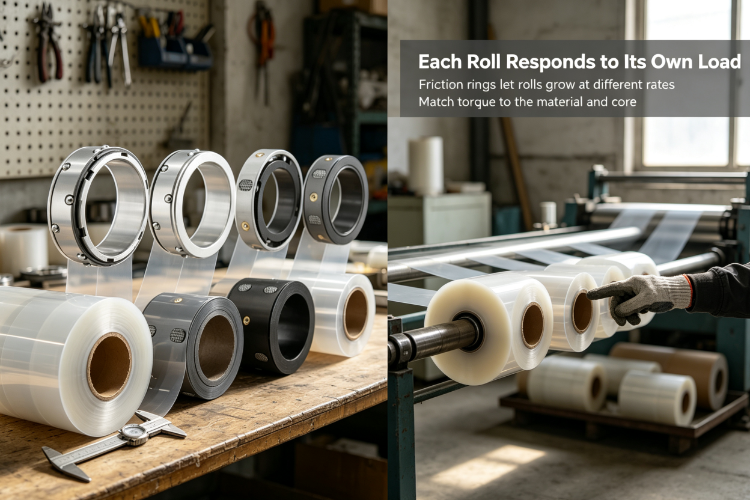
Air pressure sets the engagement force that governs friction and torque transfer. It does not measure thickness or fix the winding tension automatically. Engineers should weigh material properties, core dimensions and construction, required winding torque, friction ring characteristics, and machine speed and tension settings together.
How Do Different Materials Behave?
Thickness matters, but elasticity, stiffness, compressibility, and surface friction also shape winding.
Plastic Films
Thin film stretches under excess tension, while thicker film builds different diameters and loads. A differential shaft lets rolls respond to different loads, accommodates diameter variation, reduces tension interference between strips, and helps avoid stretching and loose winding. This matters when a converter switches film specifications on the same setup.
Paper
Grammage, stiffness, moisture sensitivity, and finish all vary. Lightweight paper wrinkles under heavy tension, and heavier grades build different loads. Independent torque helps with uneven tightness between rolls, loose edges, inconsistent hardness, and deformation. Core strength and paper compressibility belong in the selection discussion.
Laminates
Films, paper, foil, and adhesive coatings each behave differently, so excess tension may cause stretching, wrinkling, or layer defects. Attention to thickness consistency across the web, adhesive and coating characteristics, substrate stiffness, and finished roll alignment is worthwhile. The shaft works as part of a coordinated winding system and is not a stand-alone tension controller.
Why Is Independent Torque Control Valuable?
Once a parent roll is divided, each strip becomes its own winding unit, yet the strips may differ in thickness, elasticity, or surface. A shared shaft without differential movement lets one position influence its neighbors.
Diameter and Speed
For a given web speed, a larger roll turns slower than a smaller one. As rolls grow at different rates, their speed needs change independently, and friction-based movement accommodates that.
Roll Hardness
Unsuitable tension leaves rolls loose enough to shift during handling or tight enough to carry internal stress. Telescoping, dished edges, and deformation during unwinding follow. Individual torque response reduces the differences behind these defects.
Downstream Effects
Rolls move on to printing, laminating, coating, or further slitting. An unstable roll causes handling problems and disturbs the next process.
How Should the Shaft Be Configured?
Thickness alone cannot define a configuration. Material, machine, and production conditions all count.
| Selection Factor | Information to Gather |
|---|---|
| Thickness | Thickness range |
| Material type | Film, paper, foil, or laminate |
| Flexibility | Stretching and deformation behavior |
| Surface | Friction and coating characteristics |
| Core | Inner diameter and width |
| Finished rolls | Width, diameter, weight |
| Production | Machine speed and winding tension |
Friction torque must match winding needs. Too much creates unnecessary tension or heat in sensitive materials, and too little gives unstable winding and loose rolls. Friction components should be inspected regularly.
Mechanical fit matters as well. Check shaft body diameter and working length, core inner diameter and width, number of winding positions, friction ring dimensions, drive connections, and operating load.
How Can Winding Quality Be Maintained?
Set Tension by Material
Thin film needs careful control to avoid stretching, paper depends on stiffness and compressibility, and laminates may need controlled tension to protect their layers. Identical settings for very different materials are rarely appropriate.
Monitor Friction Rings
Wear, contamination, or changed friction alters torque transmission. Inspect rings and contact surfaces, check pneumatic connections, confirm consistent engagement, watch for unusual movement, and replace worn parts.
Inspect Finished Rolls
Hardness, edge alignment, surface, and layer stability give feedback.
| Observed Problem | Possible Factor | Inspection Focus |
|---|---|---|
| Loose rolls | Insufficient torque | Friction settings |
| Overly tight rolls | Excess torque or tension | Winding parameters |
| Wrinkles | Uneven tension or web alignment | Material path |
| Telescoping | Unstable winding | Roll alignment |
| Uneven hardness | Tension differences | Individual friction positions |
Corrections should consider the whole winding system instead of changing shaft pressure without finding the cause.
Why Suit Multi-Material Lines?
Converters often switch between film structures, paper grades, or composite substrates on one line. A differential shaft provides independent torque at each position, friction-based slippage that absorbs diameter differences, flexibility across slit-roll requirements, more consistent rolls, and adaptability across applications. It does not replace tension controllers, drives, or proper machine alignment, and results depend on integration with the whole rewinding system.
What Should Buyers Prepare for a Supplier Discussion?
A film shaft may need different friction characteristics from one for paper, foil, or laminates. Useful information includes material type and thickness range, core inner diameter and width, number of rolls wound together, shaft dimensions and machine specifications, finished roll diameter and weight, and current winding problems. Teams whose finished rolls vary with thickness are welcome to contact us to discuss Differential Air Shafts suited to their materials, cores, and rewinding process.
