


Ruian Chuangbo Machinery Co., Ltd. is specialized in manufacturing of machinery parts.
Anyone who has run a slitter for a full shift knows the frustration: the rolls come off the machine, and one feels like a brick while its neighbor sags in the hand. Both strips came from the same parent roll, yet they wound differently. Differential Air Shafts address this by letting each slit roll on a shared shaft respond to its own conditions through controlled friction and slip. For plants running films, paper, foil, labels, and flexible packaging, understanding how this works can change the quality of what leaves the line.
Why Do Rolls Wind to Different Hardness During Slitting?
Roll hardness describes how firmly the layers are packed together once winding ends. It affects whether a roll keeps its shape in storage, survives a truck ride, and unwinds smoothly on the next machine.
Several narrow strips wound side by side rarely end up equally tight. Even when they share a parent roll, small differences in the material change what happens at each winding position.
Uneven hardness shows up in familiar ways:
- Loose rolls: layers are not compact enough, so the roll shifts or sags when handled.
- Overly tight rolls: too much tension squeezes the material and may stretch or deform it.
- Telescoping: layers creep sideways and leave an uneven profile.
- Wrinkled surfaces: inconsistent tension folds the web during winding.
- Unstable unwinding: poorly wound rolls cause tension swings in later converting steps.
The damage goes beyond looks. These defects interrupt downstream production, add handling, and create inspection and rework.
The cause often sits in the shaft. On a conventional shared shaft, every core is tied to one rotational speed. If one strip builds a slightly larger diameter than its neighbor, it needs a different speed to keep pace with the web. Without some way to compensate, one roll tightens while another stays soft. A differential shaft removes that mechanical constraint by giving each position room to adjust.
What Factors Affect Roll Hardness Consistency?
Hardness comes from several conditions working together, and sorting them out tells you whether the shaft, the tension control, or the material needs attention.
Material Thickness and Properties
Thickness variation across a parent roll makes slit rolls grow at different rates. Materials that compress very little show these differences more clearly, since diameter follows the amount of material wound on.
| Material characteristic | Possible effect on winding |
|---|---|
| Thickness variation | Different rates of diameter growth |
| Elasticity | Different response to tension |
| Surface friction | Changes how layers interact |
| Stiffness | Influences roll structure |
| Coating | Affects friction and layer adhesion |
Plastic films may stretch under heavy tension, foil can crease or deform, and paper reacts according to its compressibility and surface. The shaft setup should reflect the real material on the line.
Uneven Tension Across Rolls
Winding tension decides how firmly layers press together. On a shared conventional shaft, differences in diameter and incoming web condition create tension variation. Operators see some rolls hardening as the run progresses, neighbors with different tightness, thin material stretching, and loose rolls that are awkward to unwind.
Changing Diameter During Rewinding
Diameter grows continuously as material builds on the core. For a given torque, tension changes as the radius changes, and when strips grow at different rates their required speeds drift apart. A differential mechanism lets each position compensate through controlled relative movement.
Conventional Shaft Limits
A standard air shaft expands to grip cores and passes rotation through the shared body. That works well when rolls have similar needs. When thickness or diameter varies between positions, every core still turns at the same speed, and the shaft alone cannot absorb the differences without help from additional winding controls.
How Do Differential Air Shafts Work?
Differential Air Shafts suit jobs where several slit rolls share one shaft but cannot follow identical winding conditions. The design combines pneumatic engagement with friction-based torque transmission, so each position can move slightly relative to the shaft and respond to its own thickness, diameter, and tension needs.
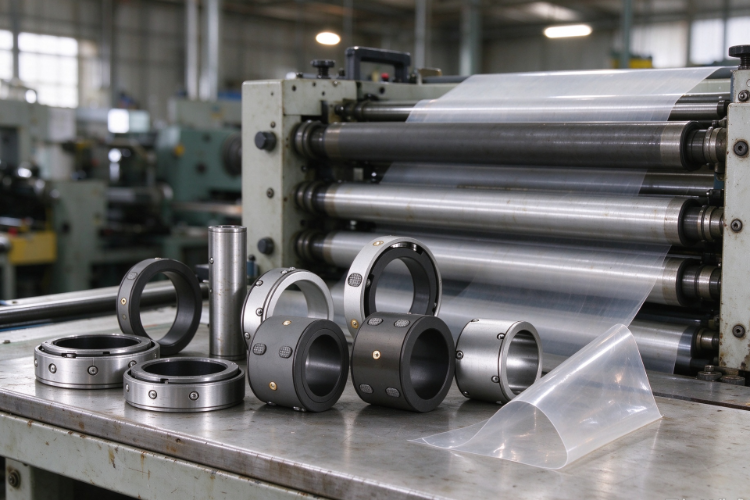
A differential shaft carries individual friction elements or differential rings along its body. Where a conventional shaft locks all cores to one speed, this design lets each position slip against the main shaft. Typical parts include:
- Shaft body: supports the winding assembly and carries rotation.
- Differential rings: give each core its own winding position.
- Friction elements: regulate torque between shaft and rings.
- Pneumatic components: apply adjustable engagement pressure.
- Supporting structures: keep the assembly stable in operation.
The exact build depends on the shaft model and the slitter it serves.
In operation, cores slide over the rings and air pressure engages the internal mechanism. As the machine turns the shaft, the friction elements pass torque to each position. When one roll needs a different speed from another, its friction element allows controlled slip. A roll with a different diameter adjusts its effective speed without dragging neighbors along. Friction and air settings decide how much torque reaches each position.
| Feature | Standard air shaft | Differential air shaft |
|---|---|---|
| Core engagement | Pneumatic expansion | Friction-based differential engagement |
| Core rotation | Shared shaft speed | Individual relative movement |
| Torque adjustment | Common drive conditions | Per-position friction adjustment |
| Multi-roll winding | Similar winding conditions | Different roll requirements |
| Diameter variation | Limited compensation | Controlled differential slip |
| Main use | General roll handling | Multi-roll slitting and rewinding |
A standard shaft secures cores. A differential shaft adds torque compensation on top of that.
How Do They Improve Roll Hardness Consistency?
The gain comes from freeing each slit roll to respond to its own winding conditions instead of depending on what its neighbors do.
When one roll needs more relative movement than another, its friction element slips on its own. That reduces the tendency of one roll to push the winding behavior of adjacent rolls through a rigid common-speed link, and tightness across the set becomes easier to control.
Diameter differences matter here. A thicker strip may build a larger roll while a thinner neighbor stays smaller. A locked shaft forces the same angular speed on both. Individual friction rings let each roll settle at the speed its diameter calls for, with a suitable torque relationship to its own material.
With sound friction settings and proper machine tension control, operators can expect to:
- reduce loose winding,
- avoid unnecessary stretching,
- improve consistency between adjacent rolls,
- keep winding behavior steadier through the run.
A differential shaft does not remove every source of tension variation. Material properties, machine settings, friction condition, and winding control all still count.
| Production concern | Potential improvement |
|---|---|
| Uneven tightness | Individual torque compensation |
| Loose winding | More controlled tension |
| Telescoping | Better winding stability |
| Material stretching | Less unnecessary tension |
| Unstable unwinding | More consistent roll structure |
| Rewinding defects | Lower risk of quality-related rework |
Rolls with a stable internal structure are easier to handle, store, ship, and unwind, which makes downstream processing more predictable for packaging films, labels, paper products, and technical materials.
Standard or Differential: Which Suits Your Line?
Start from the real production problem, not the product name.
Standard air shafts fit single-roll winding and unwinding, several rolls of similar material, steady winding requirements, and cases where secure core engagement is the main concern.
Differential Air Shafts deserve a look when several narrow rolls are produced together and their conditions differ: thickness variation across a parent roll, different finished diameters, uneven tightness between neighbors, sensitive materials needing careful tension, or repeated defects that common shaft settings cannot solve. The machine’s drive arrangement and tension control should be part of the decision.
Where Are They Used?
Any converting operation that splits a wide web into narrower rolls can benefit.
In plastic film slitting, thickness, elasticity, and surface properties vary, and differential shafts help each roll wind consistently. Paper and label stock varies in thickness, coating, and friction, so individual adjustment keeps roll formation more even. Aluminum foil needs gentle tension because stress can cause wrinkles or creases, and each slit roll can take up its own conditions. Laminated flexible packaging combines materials with different compressibility, and the shaft helps manage those differences during rewinding.
How Should You Choose a Differential Air Shaft?
Match the shaft to your material, machine, and winding needs. Before requesting a custom design, gather these details:
- Material type and thickness range
- Core inner diameter and individual core width
- Finished roll diameter and weight
- Number of winding positions
- Machine operating speed
Friction settings need thought as well. An unsuitable setting causes unstable winding, excess slip, or unwanted heat, so the configuration should account for required torque, material tension behavior, friction element design, air adjustment, and conditions throughout roll buildup. Inspect friction parts regularly.
Compatibility with existing equipment matters too: shaft length and journal dimensions, mounting arrangement, core positioning and ring layout, air connection, load limits, and maintenance needs. A manufacturer familiar with slitting and rewinding can simplify the specification.
Ready to Improve Your Rewinding Process?
When slit rolls come out with uneven hardness, changing tension for the whole machine may miss the mechanical cause. Differential Air Shafts transmit torque through individual friction elements, so rolls with different conditions can share one shaft without fighting each other.
At Ruian Chuangbo Machinery Co., Ltd. , our engineering team can review differential shaft configurations against your machine structure, core specifications, material properties, and winding requirements. If you are dealing with loose rolls, rolls that are too tight, or inconsistent winding, contact us with your core dimensions, material specifications, and machine details, and we will help identify a suitable solution for your slitting and rewinding equipment.
