


Ruian Chuangbo Machinery Co., Ltd. is specialized in manufacturing of machinery parts.
Plants that run flexible packaging, film converting, paper processing, and precision slitting are tying more of their equipment together. The winding hardware in those plants has to keep pace with changing material conditions, and a stoppage on one roll should not halt the whole line. Differential Air Shafts address this by letting several rolls sit on one shaft while each roll winds under its own friction torque. Paired with tension control equipment, drives, pneumatic components, and machine automation, they keep roll formation consistent and allow rewinding to continue smoothly.
What Are Differential Air Shafts and Why Do Automated Rewinding Machines Need Them?
Differential Air Shafts carry multiple slit rolls on a common shaft. Each roll keeps its own winding behavior, even though all of them share the same mounting.
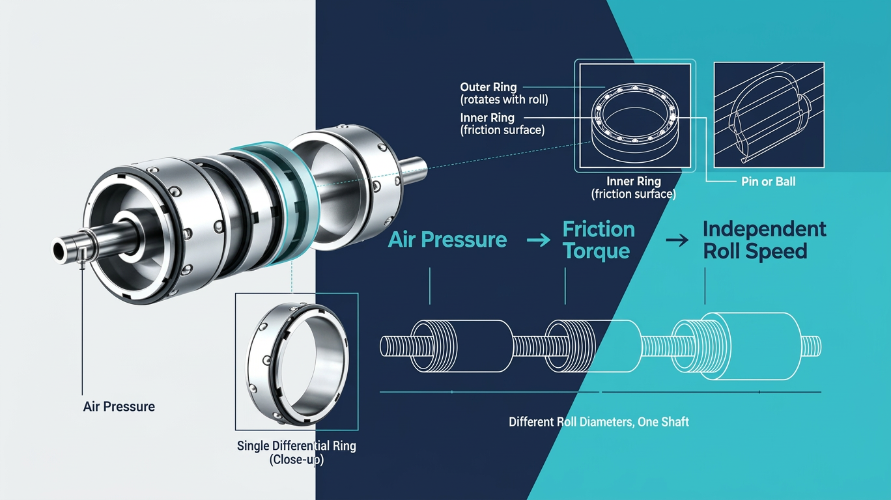
A conventional air shaft turns every mounted core together. Differential Air Shafts work differently. Separate friction elements pass torque to separate winding positions, and controlled relative movement lets rolls of unequal diameter or material behavior wind side by side. No roll is forced to copy the rotation of its neighbor.
The Mechanical Structure Supports Independent Winding
A typical shaft is assembled from several parts that act together. Each part has a clear job in the winding process.
- Shaft Body: Gives structural support and carries rotational force from the machine drive.
- Differential Rings: Hold individual winding positions and permit relative movement between rolls.
- Friction Elements: Pass controlled torque from the shaft to each winding position.
- Pneumatic Mechanism: Applies engagement pressure that sets friction behavior.
- Air Supply Connection: Brings in compressed air to keep the required operating condition.
Machine design, core dimensions, material characteristics, and the torque range all shape how these parts are arranged. Two machines may use the same components in quite different layouts.
Conventional Air Shafts and Differential Designs Serve Different Needs
A conventional air shaft grips cores and transfers rotation. Differential Air Shafts add individual torque compensation, which suits jobs where slit rolls cannot share identical winding conditions.
| Comparison | Conventional Air Shaft | Differential Air Shaft |
|---|---|---|
| Core engagement | Pneumatic expansion | Core engagement with differential friction mechanism |
| Roll movement | Generally shared rotation | Controlled relative movement |
| Torque distribution | Common drive conditions | Individual friction adjustment |
| Multiple roll winding | Suitable for similar winding requirements | Accommodates varying roll conditions |
| Typical application | General winding and unwinding | Multi-roll slitting and rewinding |
The gap between the two designs becomes clear with thin films, coated papers, and laminates. These materials react to winding tension in different ways, and shared rotation can work against them.
How Do Differential Air Shafts Work During the Rewinding Process?
Pneumatic engagement and mechanical friction control operate together here. The shaft turns with the machine drive, and each friction assembly passes torque on to its own core.
As winding continues, rolls grow to different diameters and need different rotational speeds. The friction mechanism allows controlled relative movement between winding positions, so each roll can settle at the speed it needs.
Pneumatic Pressure Regulates Friction Engagement
Compressed air activates the internal mechanism and sets the contact between the friction elements and the shaft assembly. The pressure level decides how much torque reaches each winding position.
When engagement force does not suit the material or the operating conditions, winding can turn unstable. Operators and controllers need to account for these points:
- Material thickness and mechanical properties.
- Core dimensions and winding width.
- Friction characteristics of the winding assembly.
- Required winding tension.
- Machine speed and acceleration conditions.
A well-matched pneumatic setting keeps friction behavior steady through the production cycle. Changes in material or speed may call for a matching change in pressure.
Different Roll Diameters Require Different Winding Responses
Take a slitting machine that cuts a wide film web into narrower strips. Small thickness variations across the parent web add up as each strip is rewound.
Some rolls end up larger than the ones beside them, even though all of them were fed from the same line. A rigid connection pushes every core to the same speed, which creates differences in surface speed and winding tension.
Differential Air Shafts let each winding position absorb those variations through controlled frictional slip. Neighboring rolls build their own diameters without disturbing each other.
How Do Differential Air Shafts Coordinate with Automatic Tension Control?
Tension management and shaft mechanics are closely linked. The shaft supplies adjustable friction torque, while tension control equipment watches operating conditions and adjusts machine settings.
Neither works well alone. Each relies on the other for a stable winding result.
Closed-Loop Control Connects Material Feedback with Shaft Adjustment
In a closed-loop setup, sensors measure actual web tension and report to a controller. The controller processes the signal and changes its output, which may regulate pneumatic pressure through an electro-pneumatic converter.
A typical control sequence runs as follows:
- The material travels through the machine and enters the rewinding section.
- Load cells measure web tension during operation.
- The tension controller compares the measured condition with the configured target.
- The controller adjusts the pneumatic output according to the control strategy.
- The differential shaft responds through its friction mechanism.
- The process continues with feedback from the running web.
The mechanical winding system can therefore react to changing production conditions. The loop repeats for as long as the web keeps running.
Open-Loop Control Can Use Roll Diameter Information
Some machines adjust winding parameters from roll diameter readings. An ultrasonic sensor or similar device sends diameter data to the controller.
The controller then applies a programmed relationship between diameter and the needed pneumatic or drive settings. This approach helps when a machine has no direct tension measurement, though it depends on the accuracy of the programmed material and winding parameters.
| Control Component | Function in Rewinding |
|---|---|
| Load Cell | Measures actual web tension |
| Diameter Sensor | Tracks roll diameter development |
| Tension Controller | Processes measurement signals |
| Pneumatic Regulator | Adjusts air pressure |
| Differential Air Shaft | Transfers adjustable friction torque |
| Drive System | Controls shaft rotation and machine speed |
Material sensitivity, machine configuration, and production requirements decide which arrangement suits a given line. Engineers usually weigh these factors together.
Differential Air Shafts Connect Mechanical Winding with Automated Production Lines
Modern converting equipment blends mechanical components, electronic controls, pneumatic systems, and automated material handling. Differential Air Shafts sit inside this mix as part of the rewinding assembly.
Their results depend on how well they cooperate with the equipment around them. A well-made shaft still needs suitable controls and connections.
PLC Systems Coordinate Machine Operations
A programmable logic controller manages machine sequences and coordinates signals between components. In a rewinding application, it may communicate with several systems:
- Drive inverters and motor controllers.
- Tension measurement equipment.
- Pneumatic control units.
- Roll diameter sensors.
- Web guiding systems.
- Operator interfaces.
- Automatic loading and unloading equipment.
The shaft handles mechanical torque distribution. The PLC manages the surrounding conditions through the connected control equipment, so every component keeps a defined role in the machine architecture.
HMI Interfaces Make Production Settings Easier to Manage
An operator interface opens access to production recipes and operating parameters. Depending on the machine, operators may adjust:
- Material-specific winding settings.
- Pneumatic pressure parameters.
- Machine acceleration and deceleration.
- Roll diameter settings.
- Tension control modes.
- Production sequence and changeover instructions.
With settings stored in a recipe, operators can move between material configurations without re-entering each value. Changeovers become routine and depend less on individual habits.
Automatic Loading and Unloading Reduce Manual Handling
Roll handling forms a major part of automated rewinding. When winding ends, automatic unloading equipment moves finished rolls away from the station, and the machine prepares the winding area for the next cycle.
Differential Air Shafts designed for automatic engagement or release support this flow. Integration should cover shaft removal, core positioning, pneumatic connections, mechanical clearances, and the motion of the handling equipment.
These points belong in the machine design stage. Treating them later as separate installation tasks often creates avoidable problems.
Which Production Applications Benefit from Differential Air Shafts?
Differential winding suits converting operations where several slit rolls share a shaft but develop different winding conditions. The same principle adapts to a range of materials.
Flexible Packaging and Plastic Film Processing
Film converting calls for careful attention to winding tension, since thin or extensible materials can deform under unsuitable loads. Differential Air Shafts let individual slit rolls handle differences in diameter growth and winding resistance.
They can be combined with web guiding equipment, tension sensors, slitting units, and automatic rewinding machinery.
Paper and Label Converting
Paper products differ in thickness, surface coating, stiffness, and friction. During multi-roll rewinding, these differences can affect roll formation and handling.
Individual friction adjustment helps the machine cope with variations between adjacent rolls. Winding conditions stay more even across the shaft.
Aluminum Foil and Technical Materials
Thin metal foils and specialty materials need careful mechanical handling. Too much tension can stretch or damage the material, while weak winding control may leave rolls loose or unstable.
A suitable shaft configuration with appropriate tension monitoring helps address both concerns.
| Industry | Production Challenge | Differential Shaft Application |
|---|---|---|
| Flexible Packaging | Material stretching and uneven winding | Individual friction adjustment |
| Paper Processing | Differences in roll development | Controlled multi-roll winding |
| Label Manufacturing | Narrow slit widths and varying material properties | Independent winding positions |
| Aluminum Foil | Sensitivity to mechanical tension | Adjustable friction torque |
| Laminated Materials | Different material behavior across the web | Coordinated tension management |
What Should Manufacturers Consider When Integrating Differential Air Shafts?
Choosing a shaft takes more than matching outer dimensions to an existing machine. Engineers should review the mechanical, pneumatic, electrical, and operational needs of the whole rewinding system.
Shaft Dimensions Must Match the Machine Configuration
Key mechanical points include:
- Working length and shaft diameter.
- Core inner diameter.
- Core width and positioning requirements.
- Supported roll load limit.
- Differential ring arrangement.
- Mounting and drive connections.
The shaft has to fit the machine structure and give enough support for the planned winding setup. A shaft that fits physically but carries too little load will cause trouble in service.
Material Properties Influence Friction and Torque Settings
Materials respond to winding in different ways. Thin films may need careful tension management, while paper and laminates bring their own friction and stiffness traits.
Manufacturers should share details about the materials they run, such as thickness, width, surface characteristics, and winding requirements. That information guides the choice of friction assembly and pneumatic configuration.
Pneumatic and Electrical Compatibility Must Be Checked
The pneumatic needs of Differential Air Shafts should match the available air supply and control arrangement. Engineers should also look at how the shaft relates to the tension controller, sensors, drive system, and PLC.
For existing equipment, installation space and connection compatibility need particular attention. A retrofit may involve changes to pneumatic piping, mounting arrangements, control signals, or the machine operating sequence.
Customized Shaft Design Can Support Specialized Production Requirements
Standard configurations may not suit every converting application. Some lines call for special working lengths, core dimensions, friction ring arrangements, shaft materials, or automatic engagement features.
As a manufacturer of industrial air shaft solutions, our company looks at the full operating environment when discussing customized Differential Air Shafts. The review covers the material being processed, machine structure, winding arrangement, pneumatic requirements, and planned automation functions.
This way the shaft design follows the real production process. It is treated as part of the machine, not as an isolated replacement part.
How Can Differential Air Shafts Support More Connected Manufacturing Operations?
Connected manufacturing depends on cooperation between mechanical equipment, sensors, control software, and material handling systems. Differential Air Shafts add to this by offering individual winding adjustment within a shared mechanical assembly.
Their integration can support several production objectives:
- Process consistency: Individual friction adjustment accommodates differences between slit rolls.
- Control coordination: Pneumatic settings can be linked with machine tension control strategies.
- Production flexibility: Different material configurations can be handled through suitable shaft and machine settings.
- Automated handling: Compatible shaft designs can work with automatic core positioning and finished-roll removal.
- Equipment integration: Mechanical and control interfaces can be considered during production line planning.
For equipment designers, the central question is how the shaft interacts with the whole web handling process. Mechanical characteristics, control requirements, and maintenance access all belong in the machine integration plan.
Discuss Your Differential Air Shaft Requirements with Our Engineering Team
A suitable configuration begins with an understanding of your material, rewinding process, and existing equipment. Details from your own line make the evaluation more useful.
You may be building a new automatic slitting line, upgrading an existing rewinding machine, or looking for a customized shaft for varied roll conditions. In each case, our team can help evaluate the mechanical and pneumatic requirements.
Contact our engineering team with your shaft dimensions, core specifications, material details, and machine configuration. We can then discuss Differential Air Shafts that work with your production equipment and support your winding requirements.
