


Ruian Chuangbo Machinery Co., Ltd. is specialized in manufacturing of machinery parts.
Flexible production lines, automated material handling, and compact machine designs have changed how engineers choose conveyor components. An Aluminum Roller Tube or Aluminum Tube Roller offers low weight, reduced rotational inertia, corrosion resistance, and easy machining. Together these traits cut the moving mass of a conveyor, support quicker starts and stops, and simplify installation. Packaging machinery, printing equipment, slitting and rewinding lines, coating lines, and automated conveyors are typical homes for these rollers, mainly in light-to-medium-duty service.
Why an Aluminum Tube Roller Fits Lightweight Conveyors
A lightweight conveyor needs more than a compact frame. Its rotating parts must move material smoothly without adding mechanical resistance. Roller weight, surface condition, bearing layout, and stiffness all shape how the machine behaves.
An Aluminum Tube Roller uses an aluminum alloy tube as its main body. Shafts, bearings, surface finishes, and end structures can be matched to the application. The design suits equipment that needs:
- Lower weight in moving assemblies
- Responsive starting and stopping
- Smooth material guidance
- Resistance to moisture and surface corrosion
- Flexible dimensions and custom configurations
Lower Mechanical Load
Aluminum is less dense than steel, so roller mass drops for the same dimensions. Every rotating roller adds to the total load carried by the frame and driven by the motor, and an Aluminum Roller Tube trims that load.
Practical gains show up during installation and service:
- Lighter parts are easier to carry and position.
- Selected conveyor sections can use lighter frames.
- Technicians replace rollers with less effort.
- Portable and modular conveyors become simpler to configure.
The real benefit depends on tube diameter, wall thickness, length, and internal construction. A light roller must still resist bending under its load.
Lower Rotational Inertia
Weight also affects rotational inertia, the resistance of a rotating part to speed changes. Each start, stop, or speed change forces the drive to accelerate or slow every roller. With comparable geometry, a lighter roller needs less torque for the same acceleration.
Think of a packaging line that indexes cartons between stations dozens of times per minute. Printing and film-handling machines also need coordinated roller movement to keep material stable. Proper diameter, wall thickness, bearing arrangement, and balance let an Aluminum Tube Roller support these demands.
| Operating Need | Possible Benefit |
|---|---|
| Frequent starting | Less resistance during acceleration |
| Frequent stopping | Less rotational energy to manage |
| Speed adjustment | Responsive changes in rotation |
| Lightweight products | Reduced mass in rotating assemblies |
| Compact machines | More freedom in component layout |
Lower roller inertia does not equal lower total energy use. Motor efficiency, friction, load, transmission design, and control settings all play a part.
Corrosion Behavior of an Aluminum Roller Tube
Aluminum forms a thin oxide layer in air, which gives some protection against environmental corrosion. Compared with untreated carbon steel, an Aluminum Roller Tube copes better in humid areas, where occasional moisture or routine cleaning would mark steel surfaces.
Anodizing adds a controlled oxide layer. Depending on the treatment, it can improve hardness, wear resistance, and corrosion protection. Anodized rollers appear in:
- Packaging machinery handling finished materials
- Printing equipment guiding paper or film
- Coating lines that need controlled roller surfaces
- Conveyors in humid environments
Match the finish to the contact material. A roller guiding delicate film, for instance, needs attention to smoothness and cleanliness. Aluminum does not suit every chemical exposure or washdown routine, so check chemical compatibility, sealing, and maintenance conditions before choosing it.
Machining Flexibility in an Aluminum Tube Roller
Conveyor layouts differ from one machine to another. Aluminum alloy tube responds well to cutting, turning, drilling, and other custom operations, so a roller can follow the machine drawing instead of forcing the machine to follow a stock size.
A custom roller can specify:
- Tube diameter and overall length
- Wall thickness and alloy grade
- Shaft dimensions and end connections
- Bearing seats and mounting arrangements
- Grooves or surface profiles
- Anodizing and other finishing
OEM projects benefit most, since standard dimensions rarely match a new design. Alloy selection should weigh strength, machinability, corrosion exposure, and expected load together with the tube construction.
Aluminum and Steel Rollers Compared
Aluminum suits lightweight conveying and responsive rotating assemblies. Steel stays relevant where stiffness, load capacity, or impact resistance matter more.
| Factor | Aluminum Tube Roller | Steel Roller |
|---|---|---|
| Material weight | Relatively low | Relatively high |
| Rotational inertia | Can be reduced by design | Depends on mass and geometry |
| Corrosion behavior | Forms a protective oxide layer | Depends on grade and protection |
| Machining | Suits many custom operations | Also widely machinable |
| Load handling | Needs suitable tube dimensions | Often chosen for heavy loads |
| Typical use | Light conveyors, material guidance | Heavy-duty handling |
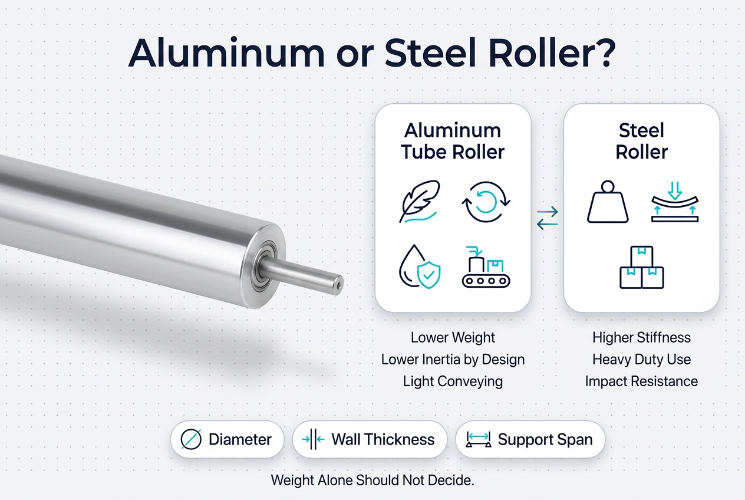
Weight alone should not decide. A thin aluminum tube over a long span may deflect under substantial load, and steel may serve better there. For lightweight products, aluminum balances component weight, response, and manufacturing flexibility.
Where Aluminum Rollers Work
Automated Conveyors
Automated conveyors. Products move between workstations, inspection areas, and packing sections. Lower rotating mass supports responsive motion when products are light. Dimensions and bearings must match the drive and product.
Packaging Machinery
Packaging machinery. Cartons, flexible packs, and containers pass through transfer and guiding sections. Low weight helps compact machines that need frequent adjustment or part replacement.
Printing Equipment
Printing equipment. Paper, labels, and film need controlled movement, which makes an aluminum guide roller useful. Surface smoothness, balance, and dimensional accuracy matter because vibration or surface defects mark the material.
Slitting and Rewinding
Slitting and rewinding. Webs pass over many rollers. Check straightness, finish, alignment, and rotational stability alongside weight.
Coating Equipment
Coating equipment. Substrates move through application and drying sections. Choose surface and finish according to the coating, cleaning needs, and process.
Selecting an Aluminum Roller Tube
Outside diameter is only the start.
- Alloy grade: Alloys differ in strength, corrosion resistance, and machinability. Discuss continuous loading or frequent acceleration with the manufacturer.
- Diameter and wall thickness: These set bending resistance, weight, and stability. Consider roller length, span between supports, load distribution, speed, acceleration, and expected deflection.
- Surface finish: Options include natural aluminum, anodized, hard anodized, and compatible coatings or coverings. Evaluate friction, cleanliness, wear, and compatibility with the material carried.
- Bearings and shafts: They must fit the frame and transmission. For faster equipment, watch concentricity, radial runout, and dynamic balance.
Working With a Custom Roller Manufacturer
An OEM builder needs a supplier who understands the application, not only the dimensions.
| Area | Confirm |
|---|---|
| Material | Alloy grade, tube condition |
| Dimensions | Diameter, length, wall thickness |
| Machining | Cutting, turning, drilling, end processing |
| Finishing | Anodizing and compatible treatments |
| Assembly | Shaft, bearing, end-cap configuration |
| Inspection | Dimensions, runout, surface, balance |
Before ordering, prepare the machine type, roller diameter and length, wall thickness or structural needs, load and speed, shaft and bearing specifications, finish and environment, and a drawing or sample.
Discuss Your Aluminum Tube Roller Project
Roller weight, rotational behavior, surface condition, and accuracy affect the whole machine. For lightweight conveyors and automated equipment, an Aluminum Tube Roller combines reduced rotating mass with corrosion resistance and machining flexibility. Our team supports packaging, printing, slitting, coating, and conveyor projects. Contact us with your drawings, dimensions, material preferences, and application details to request a customized Aluminum Roller Tube solution.
