


Ruian Chuangbo Machinery Co., Ltd. is specialized in manufacturing of machinery parts.
Conveyor designers weigh more than price and availability when they pick a roller material. Automated lines, compact machines, and energy-conscious operation all put pressure on rotating parts. An Aluminum Roller Tube gives a lighter alternative to steel, and an Aluminum Tube Roller can suit equipment that needs quick response, lower rotating mass, and resistance to everyday moisture. Weight is only one input, though. Rotational inertia, stiffness, load, surface protection, and the working environment all shape the decision, and a mismatch tends to show up later as vibration, deflection, or maintenance calls.
Aluminum Roller Tube and Steel Rollers: Basic Engineering Differences
Aluminum and steel both appear in industrial roller construction, yet their physical properties push them toward different jobs. The right choice depends on how the roller meets the machine, the product, and the surrounding air.
The Aluminum Roller Tube
An Aluminum Roller Tube forms the outer body of a roller. An Aluminum Tube Roller is the finished assembly, which adds shafts, bearings, and end fittings sized to the equipment. Typical uses include:
- Conveyors carrying light to medium loads
- Packaging and sorting equipment
- Printing and converting machinery
- Production lines with frequent acceleration and deceleration
Steel Rollers
Steel rollers suit applications that demand rigidity and resistance to heavy mechanical loading. They accept many protective finishes and material grades. A steel roller of the same dimensions carries more mass, which affects handling, installation, and drive requirements.
| Consideration | Aluminum Roller Tube | Steel Roller |
|---|---|---|
| Material weight | Lighter | Heavier |
| Rotating mass | Generally lower | Generally higher |
| Natural surface protection | Thin oxide layer | Depends on grade and treatment |
| Stiffness | Lower | Higher |
| Heavy-load suitability | Needs careful design | Often suitable |
| Handling | Easier | Takes more effort |
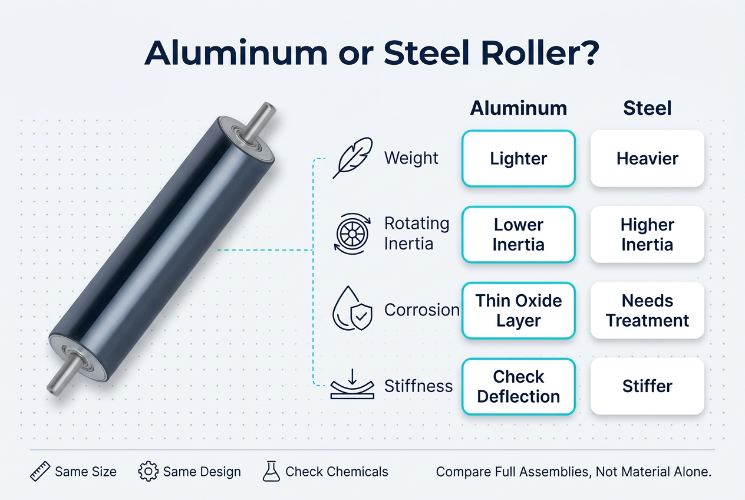
Compare rollers with the same diameter, wall thickness, length, and assembly design. Material type alone gives a misleading picture.
Weight and Its Effect on an Aluminum Tube Roller
Weight affects handling, but it also changes the load on frames, bearings, and drives, especially when rollers turn continuously or change speed often.
Lower Mass in Moving Parts
Aluminum is less dense than steel, so a tube of similar geometry weighs less. Across a conveyor with many rollers, the savings add up. Fitters lift and position lighter rollers more easily, supporting structures carry less, and compact machines gain design freedom. During maintenance, one person can often swap a roller that would otherwise need two.
Does Lighter Mean Better Performance?
A lighter roller reduces the mass the drive must accelerate. Picture a packaging line moving cartons through inspection, labeling, and sorting, with rollers that start and stop on command. Less rotating mass helps those transitions.
Weight is still one factor among several. Bearing friction, belt resistance, product load, alignment, and drive settings also decide how the machine runs.
Rotational Inertia in an Aluminum Roller Tube
Weight and inertia are related but not identical. Inertia depends on how much mass there is and how far it sits from the axis. A tube concentrates its mass at the outer radius, so geometry matters as much as material.
For a hollow cylinder, inertia can be written as:
\[ I = \frac{1}{2}m(r_o^2+r_i^2) \]
Here I is rotational inertia, m is tube mass, r_o is outer radius, and r_i is inner radius. Material and geometry must be judged together.
Where Aluminum Helps
With matching dimensions, the aluminum tube has less mass and therefore less inertia. The roller responds more readily to drive changes. Benefits include:
- Less resistance during acceleration
- Better response in start-stop cycles
- Lower rotating mass in automated assemblies
- More flexibility when matching drive components
The gain depends on the whole assembly, since shafts, bearings, and end fittings also rotate.
Automated Production
Coordinated conveyors, robotic handling, and packaging stations rely on predictable roller response. An Aluminum Roller Tube suits machines with frequent speed adjustments. On heavy continuous conveyors, stiffness and load capacity usually outweigh the benefit of lower inertia.
Corrosion Resistance of an Aluminum Tube Roller
Humid production areas, washdown zones, and facilities using cleaning chemicals test roller surfaces. Service life, surface condition, and upkeep deserve weight alongside mechanical performance.
Aluminum
Aluminum forms a thin oxide layer in air that slows further oxidation under suitable conditions. It does not produce the red rust seen on carbon steel. That means less worry in many indoor humid areas and less reliance on anti-rust paint.
Resistance has limits. Some cleaning agents, salts, and industrial chemicals attack aluminum, so check the substances actually present in the plant.
Steel
Carbon steel rusts when moisture and oxygen reach it. Protection options include paint, powder coating, galvanizing, and corrosion-resistant grades. A scratched coating exposes bare metal, and corrosion can begin there. Stainless steel improves resistance, although grade and chemical exposure still matter.
| Environment | Aluminum Roller Tube | Steel Roller |
|---|---|---|
| Dry indoor | Suitable | Suitable |
| Humid areas | Suitable after assessment | Protective treatment may be needed |
| Frequent washdown | Check chemical compatibility | Stainless may fit |
| Salt exposure | Needs alloy and protection review | Corrosion-resistant grade may be needed |
| Chemical processing | Depends on compatibility | Depends on grade and protection |
Galvanic corrosion deserves attention too. Aluminum touching certain dissimilar metals in the presence of moisture can corrode at the contact point. Proper pairing, insulation, and assembly design prevent it.
Load Capacity and Stiffness
A light roller is not automatically a weak one. Strength and stiffness differ, and both affect behavior under load.
Steel is stiffer, so a steel tube of the same geometry bends less. Aluminum performs well when wall thickness and support are designed correctly, as on conveyors carrying packaged goods or light production materials. Heavy industrial loads call for a careful check of deflection, stress, shaft support, and bearings.
Load capacity of an Aluminum Tube Roller depends on:
- Tube diameter: influences bending behavior
- Wall thickness: affects resistance to deformation
- Roller length: longer unsupported spans deflect more
- Shaft configuration: determines how load reaches the frame
- Bearing arrangement: affects support and load distribution
- Operating conditions: speed, impact, vibration, and product type
Steel remains practical for heavy material conveying, processing machinery, repeated impact, and long rollers under significant load. Aluminum becomes a candidate once the design meets structural needs while benefiting from lower rotating mass.
Where an Aluminum Roller Tube Fits
Rollers interact with belts, bearings, motors, frames, and products, so the application drives the material choice.
- Conveyors and material handling: light-duty sections, transfer stations, sorting equipment, and modular systems, where lower mass eases installation and repositioning.
- Packaging and printing: films, paper, and flexible materials pass over rollers whose finish, accuracy, and alignment matter. Reduced rotating mass supports responsive operation.
- Automated manufacturing: product transfer and positioning in coordinated lines, within the load limits of the design.
| Application | Aluminum Tube Roller | Steel Roller |
|---|---|---|
| Light conveyors | Suitable | Suitable |
| Packaging machinery | Suitable | Suitable |
| Printing equipment | Suitable with proper finish | Suitable |
| Automated transfer | Suitable where loads allow | Suitable |
| Heavy handling | Needs structural review | Often suitable |
| Corrosive conditions | Needs alloy and chemical review | Needs grade or protection |
Consider the transported product as well. A roller that handles rigid cartons may not give the surface a delicate or coated film requires.
Specifying an Aluminum Roller Tube
A clear specification helps a manufacturer recommend a suitable configuration.
- Mechanical requirements. State outer diameter, length, wall thickness, product weight and distribution, operating speed, shaft and bearing arrangement, and whether the roller runs continuously or starts and stops often.
- Alloy selection. Alloys balance strength, formability, machinability, and corrosion resistance differently. Weigh loading, surface finish, machining, environment, and compatibility with connected parts. Surface treatment may be needed where chemicals, abrasion, or frequent cleaning are present.
- Customization. Standard tubes do not fit every design.
| Item | Consideration |
|---|---|
| Diameter | Match to machine design |
| Wall thickness | Structural requirements |
| Length | Installation dimensions |
| Machining | Connection and assembly needs |
| Surface finish | Contact conditions and appearance |
| End fittings | Shaft and bearing compatibility |
Discuss Your Aluminum Roller Tube Project With CBB Machine
Choosing between aluminum and steel changes the mechanical design, operating behavior, and maintenance routine of a roller. The choice should take weight, inertia, stiffness, and exposure to corrosion into account as a whole.
CBB Machine welcomes inquiries from equipment manufacturers, engineers, and industrial buyers. Prepare the intended equipment, tube dimensions, material preferences, expected loads, finish requirements, and any special machining needs. Send your drawings and application details to discuss an Aluminum Roller Tube or Aluminum Tube Roller configuration for your equipment.
