


Ruian Chuangbo Machinery Co., Ltd. is specialized in manufacturing of machinery parts.
Inconsistent tension in a winding system does not announce itself cleanly. It shows up as uneven roll density, intermittent film tears, registration errors on printed material, or wire that stretches unevenly across a production run. The root cause is usually torque variation at the braking stage — the point where the brake's output should be steady and predictable but is instead fluctuating with speed changes, temperature shifts, or mechanical wear. Conventional friction brakes and simple mechanical systems rarely hold torque consistently under those conditions. That is why precision-demanding applications in printing, packaging, and wire processing have settled on a different approach. An Electromagnetic Powder Brake offers something that mechanical systems cannot: torque output that is proportional to the excitation current fed into it, smooth across a wide slip range, and stable regardless of rotational speed. It is a fundamentally different operating principle, and the performance difference is visible in the quality of the finished product.
What Is an Electromagnetic Powder Brake?
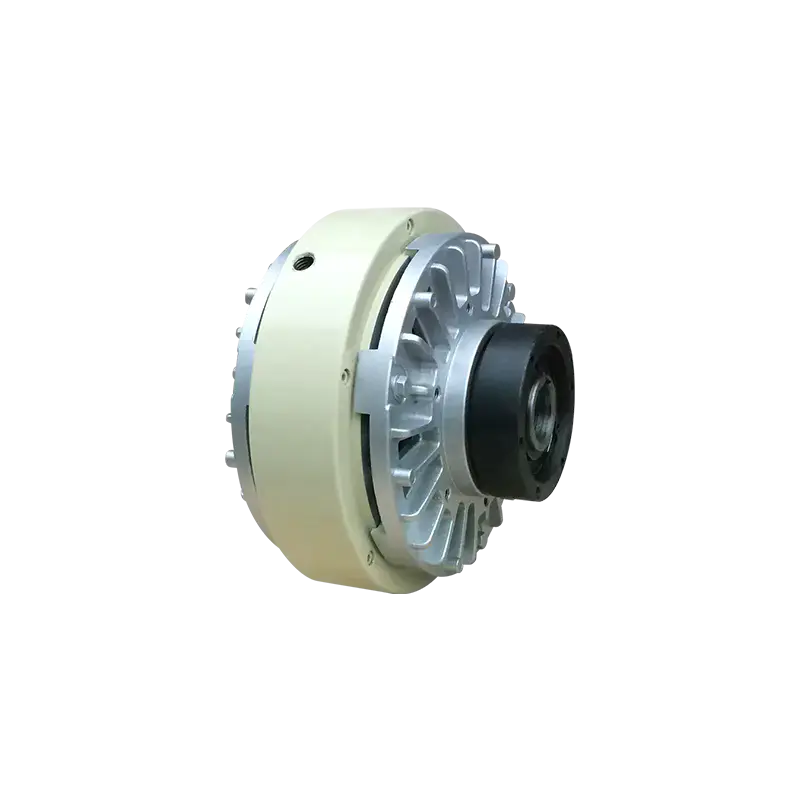
The Operating Principle Behind the Control
An electromagnetic powder brake transmits torque through a controlled layer of magnetic powder — fine ferromagnetic particles suspended between the drive and driven components. When electrical current flows through the coil, it creates a magnetic field that causes the powder particles to form chains aligned with the field direction. These chains create a friction-like resistance between the rotating surfaces, producing torque that resists relative motion.
The key relationship: torque output is proportional to the excitation current. Increase the current, more powder chains form, resistance increases, torque goes up. Reduce the current, the chains relax, torque drops. The control is smooth, continuous, and does not require mechanical contact between the drive surfaces themselves. The powder layer acts as a transmitting medium rather than a wear surface in the traditional sense.
This principle has practical consequences that separate it from conventional braking approaches in any application where torque stability and control precision matter.
Why Does Torque Stability Matter So Much in Production?
The Real Cost of Torque Variation on the Process Line
A brake that produces variable torque output creates a ripple effect through the entire downstream process. In a roll-to-roll material handling system, torque variation at the unwind or tension brake translates directly into tension fluctuation in the web. That fluctuation produces stretch in thin films, registration error in printed substrates, and density variation in wound rolls.
Consider what this looks like in practice. A flexible packaging line running printed film needs consistent tension through the printing stations to maintain color registration. If the brake torque surges slightly when the roll diameter decreases, or dips when the line slows for a splice, the film position shifts fractionally at the print head. Over a production run, that accumulates into visible misregistration — product that cannot be sold.
In wire and cable production, the equivalent problem is diameter variation. Torque instability at the capstan or payoff creates speed variation. Speed variation changes the drawing tension. Drawing tension variation changes the wire diameter. The entire downstream quality specification depends on a steady, controllable braking force at the upstream point.
Magnetic powder brake systems address this because their torque output tracks the control signal cleanly, without the stick-slip behavior of friction brakes or the torque spikes that mechanical engagement creates.
How Does Current Control Translate to Torque Precision?
The Electrical Control of a Mechanical Output
One of the practical advantages of electromagnetic actuation is the accessibility of the control variable. Torque is set by adjusting current. Current is easy to measure, adjust, and integrate into a feedback loop. A tension controller reading a dancer roll or a load cell can output a current command to the brake and close the loop on web tension without any mechanical linkage or manual adjustment.
The proportionality between current and torque holds across a range of operating conditions. Whether the roll is running at high speed with full diameter, or slowing toward a splice at reduced diameter, the torque delivered by the brake tracks the commanded current. The operator or control system sets the tension target; the brake delivers it.
This is the connection between electromagnetic powder brake design and automation system integration. The brake is not just a mechanical component — it is a controllable element in a closed-loop system. Its output is predictable, programmable, and adjustable in real time. That programmability is what makes it suitable for modern production lines where tension profiles change with material type, roll diameter, or production speed.
Low-Speed Performance: Where Other Systems Fall Short
Why Speed Dependence Is a Hidden Problem
Many conventional braking systems — including friction brakes and some hysteresis devices — produce torque output that is influenced by rotational speed. As speed changes, torque changes, even if the control setting has not been adjusted. In applications with wide speed variation — acceleration, deceleration, crawl speeds for threading, and full-speed production — this speed dependence creates a moving target for tension control.
A magnetic powder brake generates torque based on the magnetic field strength, not on the relative rotational speed between its internal components. Within its operating range, the torque output at low speed is essentially the same as at high speed for a given current setting. This speed-independence is particularly valuable during startup sequences, diameter changes that alter line speed, and controlled deceleration phases.
In textile machinery, this shows up clearly. Yarn tension must be maintained during the entire winding cycle — from the moment the spindle starts to the point where the full package is doffed. If the brake torque changes with speed, the tension program becomes unmanageable without continuous manual correction. Speed-independent torque removes that variable from the equation.
Comparing Powder Brakes to Alternative Braking Technologies
Different braking technologies serve different application requirements. Understanding where each category fits clarifies why powder brakes occupy a specific and valuable position in precision tension control.
| Braking Technology | Torque Control Method | Speed Dependence | Smooth Slip Operation | Typical Application |
|---|---|---|---|---|
| Magnetic powder brake | Excitation current | Low | Strong | Precision tension, winding, printing |
| Hysteresis brake | Magnetic field | Very low | Very smooth | High-precision, lower torque range |
| Friction brake | Mechanical pressure | High | Moderate | General braking, not tension control |
| Eddy current brake | Magnetic field + speed | High | Smooth at speed | Dynamic braking, test equipment |
| Mechanical disc brake | Hydraulic/pneumatic pressure | Moderate | Poor at low speed | Heavy load stopping |
The powder brake occupies a useful position: broader torque range than hysteresis brakes, far smoother and more controllable than friction brakes, and speed-independent in a way that eddy current brakes are not. For tension control in winding, printing, film processing, and wire handling, this combination of properties is what makes powder brakes the industry standard choice.
Does Heat Affect Powder Brake Performance?
Thermal Management in Continuous Operation
In sustained operation — particularly on high-speed lines or in applications with continuous slip — the powder brake generates heat. The magnetic powder absorbs and transmits mechanical energy as torque, but some of that energy becomes heat. If the brake cannot dissipate that heat adequately, the operating temperature rises, and at elevated temperatures, the powder's magnetic properties and chain-forming behavior can change.
This is not a fatal limitation. It is an engineering parameter that shapes how the brake is sized and cooled for a given duty cycle.
Practical thermal management approaches:
- Correct sizing — selecting a brake with adequate rated power for the duty cycle prevents chronic overtemperature operation
- Active cooling — fan-cooled housings increase heat dissipation in high-duty applications
- Water-cooled variants — for continuous heavy-duty operation, water-cooled powder brake designs handle sustained thermal loads that air cooling cannot
Understanding the thermal rating of the brake and the actual heat generation in the application is a specification step that is sometimes skipped, causing early performance degradation. Magnetic powder brake manufacturers who understand this provide thermal guidance as part of the selection process, not as an afterthought.
Integration With Tension Control Systems
How the Brake Connects to the Automation Layer
A powder brake on its own is a torque-controllable component. Its full potential is realized when integrated into a tension control system that closes the loop on actual web or material tension.
A typical integration path:
- A tension sensor — load cell, dancer roll, or tension roller — measures actual material tension in the process
- The tension controller compares measured tension against the setpoint
- The controller outputs a current command to the brake power supply
- The power supply adjusts the excitation current to the brake coil
- The brake torque changes, adjusting the drag on the unwind roll
- Web tension moves toward the setpoint, and the loop continues
This architecture is standard in high-end printing and packaging lines. The powder brake is the actuator in the tension control loop — its fast current response and proportional torque output make it a well-suited element for real-time closed-loop control.
For simpler applications without a full tension control system, manual current adjustment through a potentiometer or a basic controller still provides considerably more stable and repeatable tension than mechanical friction brakes, simply because the electrical control is smoother and more adjustable than mechanical adjustment.
When Is a Powder Brake the Right Choice?
Matching the Technology to the Application
Powder brakes are well-suited to applications where several conditions apply together:
- Precise, repeatable tension is required — not just general drag, but controlled tension that can be set to a target and maintained
- Speed variation is normal — the application accelerates, decelerates, or runs at variable speed and needs consistent torque through that range
- Slip operation is continuous or frequent — the brake operates with slip between its input and output as a normal condition, not as a transient event
- Automation integration is planned or existing — the brake's electrical control interface connects naturally to a tension controller or PLC
Applications where a powder brake may be oversized or unnecessary include simple stopping duty (where a friction brake or motor brake is adequate), very high torque requirements that exceed the powder brake's range (where hydraulic or mechanical brakes are more practical), and very short-duty, intermittent cycles where the slip heat generation is manageable with simpler technology.
Selecting a Powder Brake Supplier Who Understands the Application
Powder brake performance in production depends on specification accuracy — getting the torque range, thermal rating, and control interface right for the specific machine and duty cycle. A generic catalog selection without application review frequently produces a brake that either underperforms or is oversized for the actual duty, both of which create problems that show up after installation rather than before. Ruian Chuangbo Machinery Co., Ltd. develops electromagnetic powder brakes and tension control components for industrial winding, printing, packaging, and wire processing applications. Their product range covers a variety of torque ratings, cooling configurations, and control interface options suited to both standalone tension control and integrated automation system applications. If you are specifying powder brake components for a new machine build, a system upgrade, or a volume procurement project, reaching out to discuss the application parameters — torque range, duty cycle, control interface, and thermal environment — is a practical starting point for selecting the right component before the installation rather than adjusting it afterward.
